Choosing an AMR or AGV charging solution is not simply a battery or charger decision. It is an operational infrastructure decision that can influence robot availability, fleet sizing, throughput, facility layout, and total cost of ownership.
For warehouse operators, manufacturers, robotics OEMs, and system integrators, the right charging architecture depends on how robots actually work, where they move, how much energy they consume, and how their operating requirements will evolve.
As mobile robot fleets expand, evaluating charging infrastructure solely by charging speed or hardware cost becomes increasingly limiting.
This guide outlines seven criteria for evaluating AMR and AGV charging systems, including conventional dock charging, opportunity charging, and Power-in-Motion.
1. Start With Robot Availability, Not Charging Speed
The first question should not be: How quickly can this robot recharge?
It should be: How much productive operating time does the charging architecture allow?
Traditional charging often requires a robot to leave its assigned workflow, travel to a charger, recharge, and return to productive operations.
The resulting interruption may extend beyond the charging session itself.
A more useful evaluation considers:
- Travel time to and from charging stations
- Time spent waiting for an available charger
- Actual charging duration
- Repositioning and return-to-work delays
- The impact on robot availability during peak demand
For example, two charging solutions may deliver similar electrical power but have very different effects on productive robot time.
This distinction is essential because fleet productivity depends on operational availability, not charging speed alone.
2. Evaluate the Energy Balance Across the Actual Workflow
Can the robot receive sufficient energy during its normal operating cycle to meet its energy consumption?
This is particularly important when evaluating opportunity charging or in-motion power delivery.
The analysis should consider average energy consumption, energy delivered during the operating cycle, route characteristics, robot speed, and time spent at recurring workstations.
The fundamental relationship is:
Net energy balance = Energy delivered − Energy consumed
If the energy delivered during a representative operating cycle meets the robot’s energy requirements, the operation may be able to reduce its dependence on dedicated charging sessions.
However, average performance alone is not sufficient.
Engineers should also examine demanding operating conditions, including peak utilization, longer routes, variable payloads, and periods when robots spend less time at potential energy delivery points.
CaPow’s Uptime Calculator approaches this problem by modeling robot routes, speed, stopping points, power consumption, and energy delivery.
The objective is to understand whether the energy architecture can support the actual duty cycle before making infrastructure decisions.
3. Compare Charging Architectures by Their Operational Requirements
Different charging approaches solve different operational problems.
| Charging approach | How it works | Key evaluation consideration |
|---|
| Stationary dock charging | Robot travels to a dedicated charger | Charging-related workflow interruption |
| Fast charging | Higher-power charging reduces charging duration | Whether travel, docking, and waiting remain necessary |
| Opportunity charging | Robot receives energy during scheduled or natural stops | Whether existing stopping periods provide sufficient energy |
| Power-in-Motion | Compatible robots receive energy during normal movement or work | Whether route coverage and energy delivery meet the operational duty cycle |
There is no universally optimal architecture.
A low-utilization fleet with predictable idle periods may operate efficiently with stationary charging.
A high-utilization fleet facing continuous demand may benefit from an architecture that reduces the need for dedicated charging interruptions.
The key is to compare solutions against the same operational requirements, rather than relying on charger specifications in isolation.
4. Account for Fleet Size and Hidden Capacity Requirements
Charging infrastructure can influence how many robots are needed to meet a given throughput requirement.
If part of the fleet is regularly unavailable for charging, operators may need additional robots to maintain the required level of productivity.
This introduces an important distinction:
The number of robots purchased is not necessarily the number of robots available for productive work.
For an initial capacity assessment, operators can examine:
Required fleet size ≈ Concurrent robot demand ÷ Productive availability fraction
This simplified relationship illustrates the effect of availability on capacity planning. Actual fleet sizing also depends on task allocation, travel time, queueing, demand variability, and the performance of the fleet management system.
An effective charging evaluation should therefore compare the required fleet size under each energy architecture.
Reducing charging-related unavailability may create an opportunity to improve throughput with an existing fleet or avoid additional robot purchases as operations expand.
5. Evaluate Brownfield and Greenfield Deployments Differently
Charging infrastructure decisions depend heavily on whether the facility is already operating or is being designed from scratch.
Brownfield: Improving an Existing Operation
In an established warehouse or factory, operators need to consider integration with existing robots, routes, software, and infrastructure.
Key questions include:
- Can the solution be retrofitted to the existing fleet?
- Will installation require operational shutdowns?
- Can existing robot routes remain unchanged?
- Does the system require new charging zones?
- Can deployment be phased without disrupting production?
Greenfield: Designing a New Operation
New facilities offer an opportunity to evaluate energy infrastructure before robot routes and facility layouts are finalized.
The relevant questions become:
- How many robots are required to meet projected throughput?
- How much space must be reserved for charging?
- Can power delivery be integrated into productive operating areas?
- How will the infrastructure support future fleet expansion?
The distinction matters because the economics of retrofitting an existing operation can differ substantially from designing energy delivery into a new facility.
6. Calculate Total Cost of Ownership, Not Just Hardware Cost
The purchase price of a charging system is only one component of its economic impact.
A meaningful comparison should account for:
Infrastructure costs
- Charging equipment or energy transmitters
- Robot-side integration
- Installation and commissioning
- Facility modifications, where required
Operating costs
- Maintenance and support
- Software and monitoring
- Electricity and conversion losses
- Battery replacement and servicing
Productivity-related costs
- Charging-related unavailable time
- Additional robots needed to maintain throughput
- Space allocated to charging infrastructure
- Operational interruptions associated with charging
Not every reduction in charging downtime translates directly into financial savings.
For example, recovering robot-hours creates measurable economic value when those hours increase throughput, support growth, reduce required fleet capacity, or otherwise remove a genuine operational constraint.
A credible business case must distinguish between recovered capacity and cash savings.
It should also clearly state the assumptions used to calculate payback.
7. Require Evidence Under Real Operating Conditions
A successful laboratory demonstration establishes technical feasibility. A production evaluation must also establish operational performance.
When assessing an AMR charging solution, request evidence covering:
- Performance under representative workload conditions
- Compatibility with the target robots
- Installation and integration requirements
- Measured charging-related availability
- Maintenance and service requirements
- Performance during peak utilization
- A clearly defined comparison baseline
One example is CaPow’s Hyundai Glovis case study, which compares conventionally powered mobile robots with robots equipped with Power-in-Motion technology.
The study reports that the CaPow-enabled fleet maintained productive operation without dedicated charging interruptions under the evaluated conditions, while the conventional fleet experienced charging-related losses.
Results from a specific deployment should not be treated as universal guarantees.
They should be evaluated alongside differences in robot types, routes, duty cycles, power requirements, and operating environments.
How CaPow Approaches AMR and AGV Power Delivery
CaPow develops Power-in-Motion technology for industrial mobile robots.
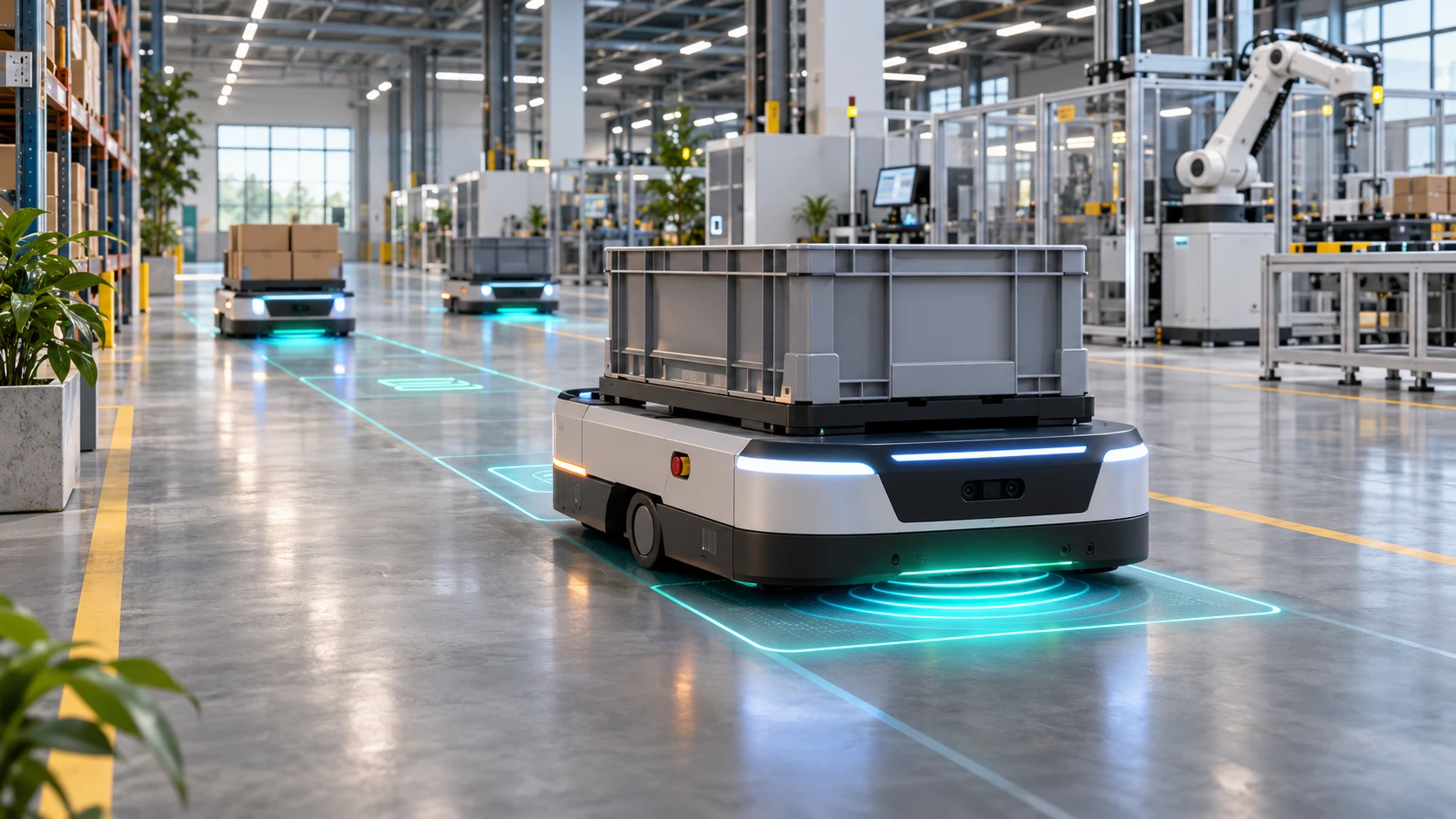
Its Genesis platform uses strategically positioned floor-mounted transmitters and robot-mounted receivers to deliver energy to compatible AMRs and AGVs during their normal operating cycle.
Rather than requiring every charging event to become a separate destination, the architecture integrates energy delivery into selected sections of the existing workflow.
This approach changes the evaluation question from How do we charge robots faster? to How do we provide energy without interrupting their productive operation?
CaPow also offers GEMS, an energy management software layer designed to provide operational visibility into power delivery across robotic fleets.
Learn more about CaPow’s Power-in-Motion technology.
Final Consideration: Design Energy Around the Operation
The most effective AMR charging strategy starts with the operation itself.
Before selecting a charging technology, operators should understand where productive time is lost, how energy requirements change across the duty cycle, and whether charging infrastructure is limiting their ability to scale.
The goal is not simply to improve charging. It is to design an energy infrastructure that supports the productivity requirements of the entire robotic fleet.
For manufacturers, warehouse operators, and system integrators evaluating high-utilization AMR and AGV fleets, Power-in-Motion introduces an alternative worth assessing alongside conventional charging architectures.
Explore CaPow’s Power-in-Motion technology or contact CaPow to discuss an application-specific evaluation.