When manufacturers and warehouse operators search for
AGV charging,
AMR charging,
wireless charging for robots or
robot charging systems, they are usually trying to solve a much bigger problem.
They are trying to keep robots working.
As autonomous mobile robot fleets expand, charging is no longer just a battery-management issue. It directly affects robot availability, fleet utilization, throughput and the number of robots required to complete the job.
That changes the question.
Instead of asking:
What is the best way to charge an AMR or AGV?
Operators should increasingly ask:
How can we keep the fleet productive without designing operations around charging?
That is where Power-in-Motion changes the model.
The Real Cost of Robot Charging Is Lost Productivity
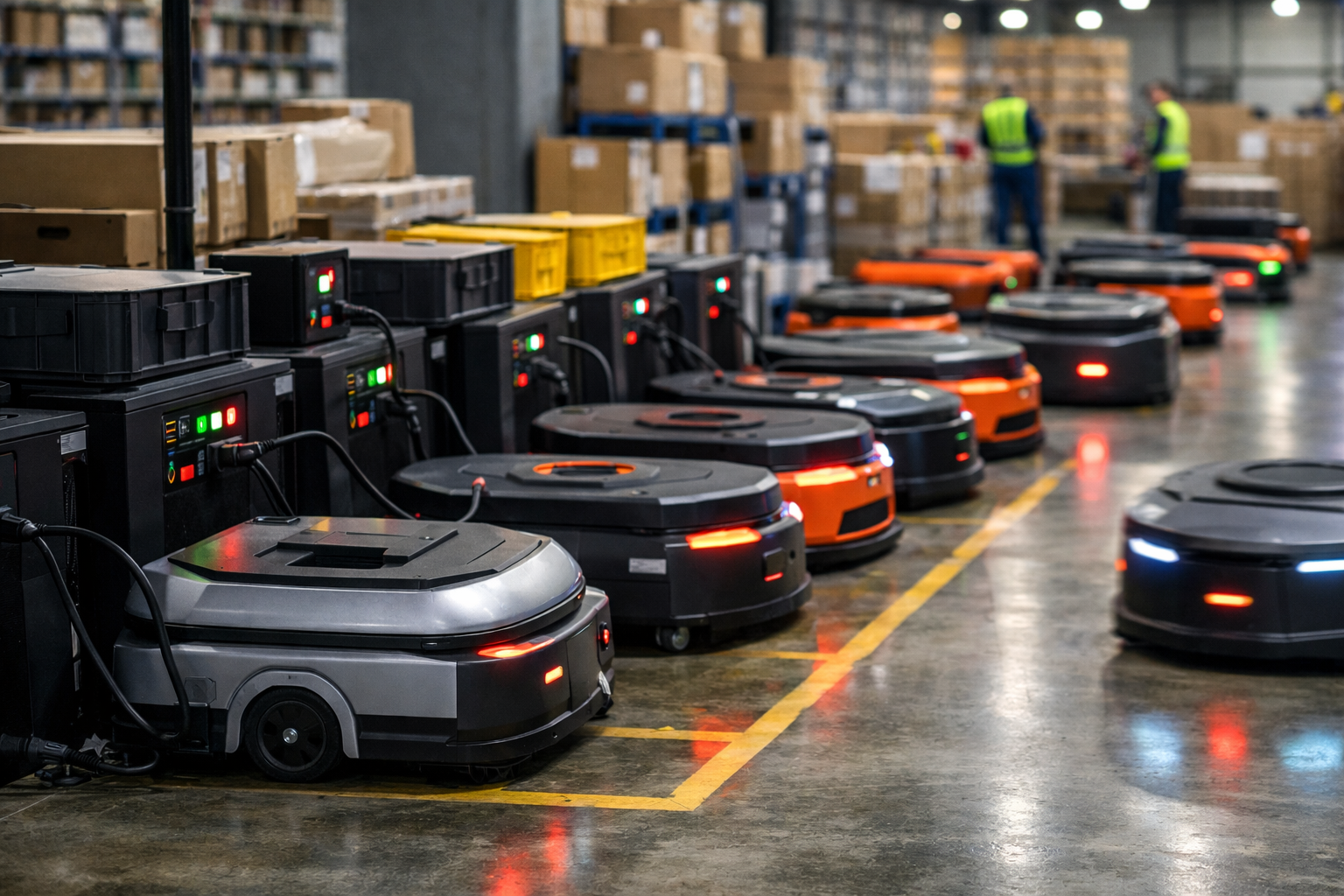
Traditional AMR and AGV charging requires robots to dedicate part of their operating cycle to energy replenishment.
Depending on the system, a robot may need to:
- leave its productive route
- travel to a charger
- align or dock
- remain unavailable while charging
- return to operation
The battery receives energy.
But the operation loses productive robot time.
At small scale, that may be manageable.
At fleet scale, repeated charging events can affect overall capacity.
If a percentage of
robots is unavailable because of charging, operators may compensate through scheduling, larger batteries, more charging infrastructure or additional robots.
The result is that a problem usually described as
robot charging becomes a
productivity problem.
Charging Technology Is Not the Goal
There are several ways to provide energy to AMRs and AGVs.
Stationary charging
A robot travels to a charging station and remains there while receiving energy.
This solves the battery requirement, but the robot is unavailable during the charging process.
Opportunity charging
Robots receive energy during natural pauses in their workflow.
This can reduce the need for long charging sessions, but productivity still depends on where the charger is located, how long the robot must remain there and whether charging constrains the operating cycle.
Wireless charging
Wireless charging removes the physical charging connector.
This can simplify automated charging, but it does not automatically eliminate charging downtime.
A wireless charging system can still require the robot to reach a specific location, stop and remain positioned over a charger.
That is an important distinction.
Removing a cable is not the same as removing charging from the workflow.
From Robot Charging to Power-in-Motion
CaPow approaches the problem from a different direction.
The objective is not to build a faster charging stop.
The objective is to reduce or eliminate the need for a dedicated charging stop.
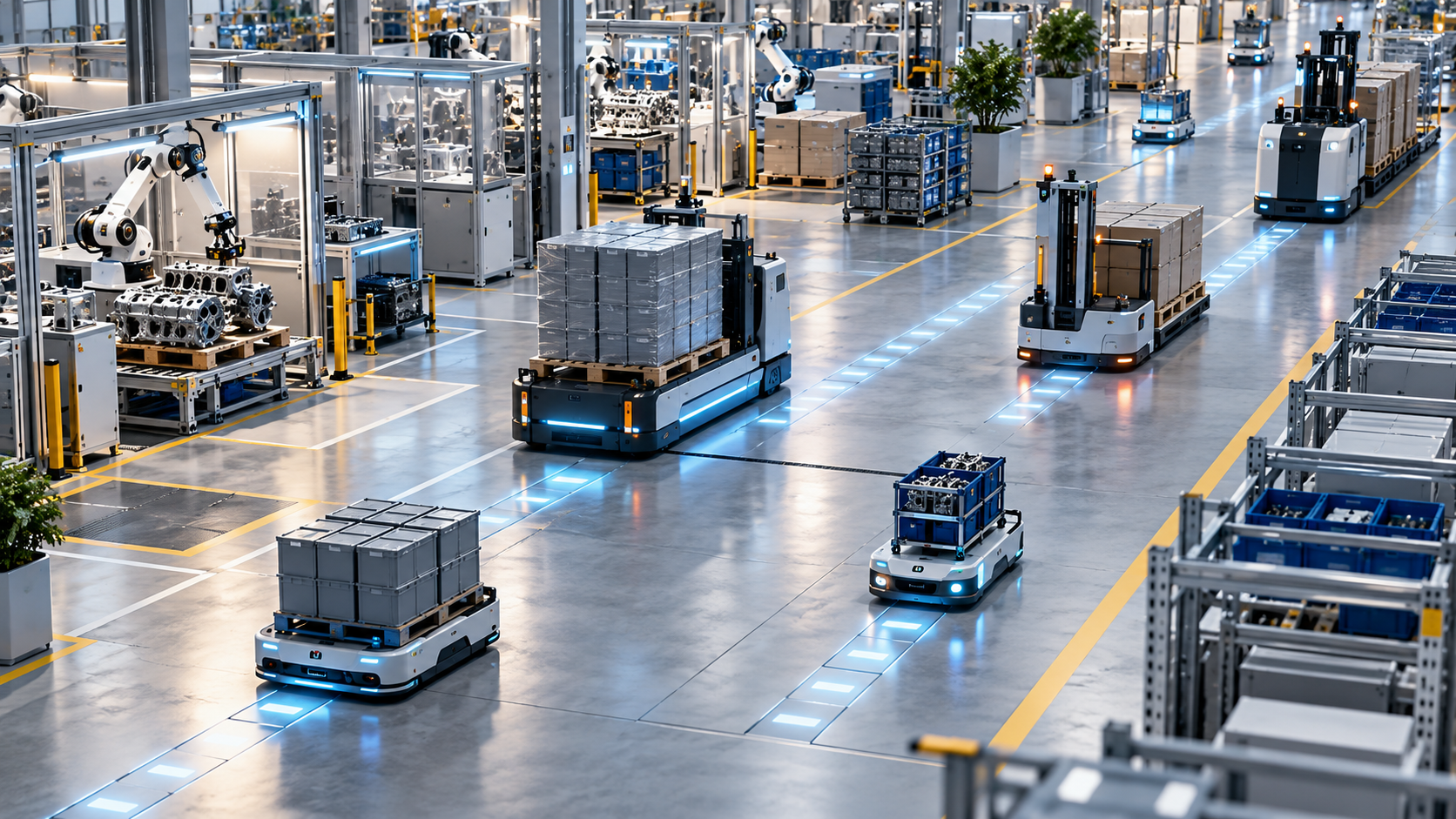
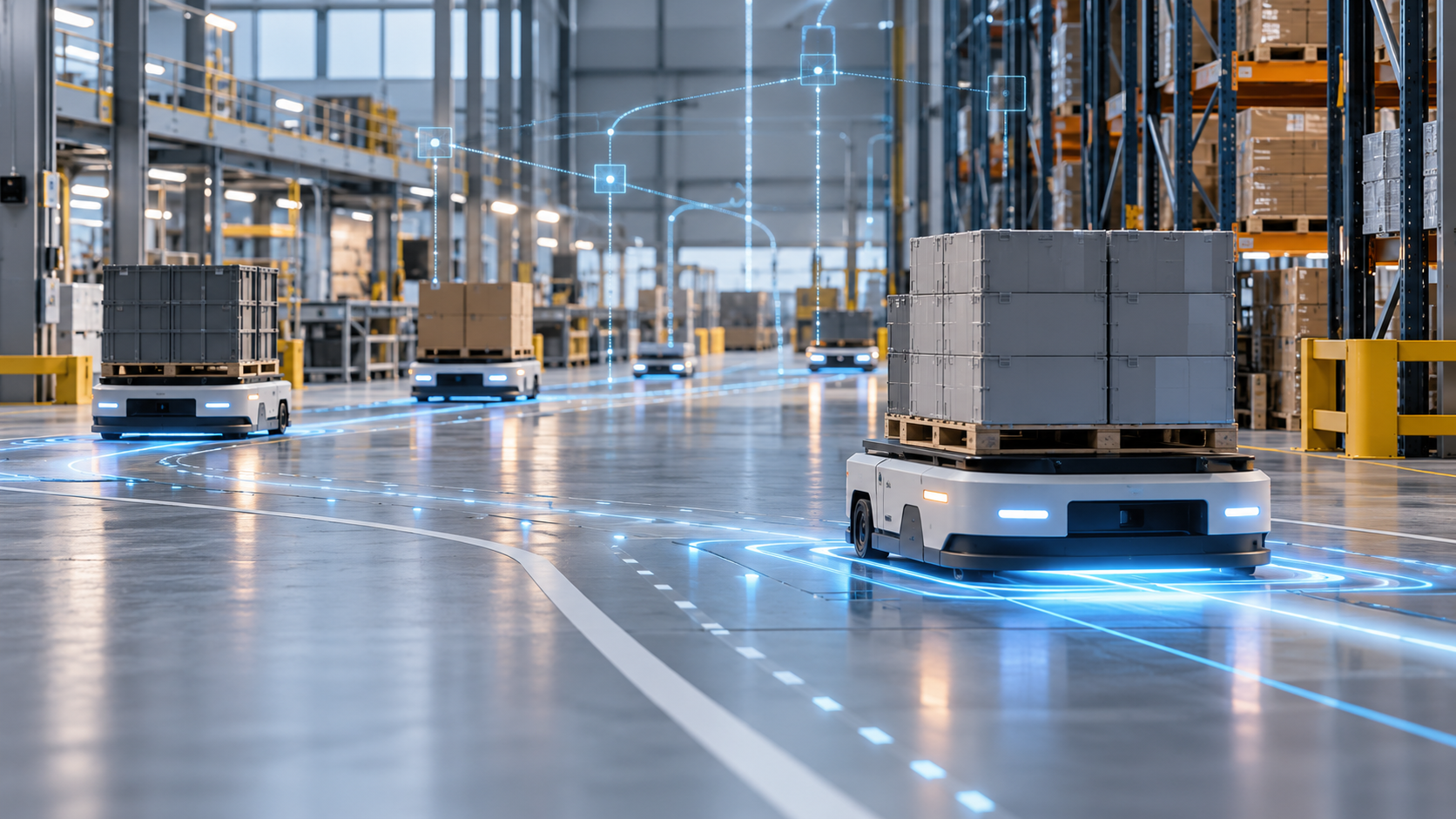
CaPow’s Genesis Power-in-Motion platform delivers energy to compatible AMRs and AGVs at selected points along their normal operating routes.
Instead of sending the robot to the energy source, the energy infrastructure is integrated into the areas where the robot is already working.
That changes the operating model from:
Work → Leave the workflow → Charge → Return to work
to:
Work → Receive energy during normal operation → Keep working
The technology transfers electrical energy.
But the product outcome is
productivity.
Why Power-in-Motion Is a Productivity Solution
The value of Power-in-Motion is not measured simply by how much energy is transferred.
The more important question is what that energy allows the fleet to do.
When robots can receive energy without dedicating productive time to charging, operators can potentially improve:
Robot availability
Robots can spend more of their operating cycle performing productive tasks rather than waiting at charging stations.
Fleet utilization
More of the installed fleet can remain available for work at the same time.
Throughput
When charging-related downtime is reduced, existing robots can spend more time moving materials and completing missions.
Fleet sizing
If charging downtime requires additional robots to maintain required throughput, reducing that downtime can change how many robots an operation needs.
Battery requirements
Continuous or frequent energy delivery can reduce the need to design the entire operating cycle around a large onboard energy reserve.
Infrastructure efficiency
Energy delivery can become part of the robot route rather than a separate destination within the facility.
This is why CaPow should not be evaluated only against other charging technologies.
It should be evaluated against the
cost of non-productive robot time.
A Published Example: Hyundai Glovis
The productivity impact can be seen in CaPow’s published Hyundai Glovis deployment.
In the reported operation, traditionally powered robots had an average work-to-charge ratio of 6.75:1.
CaPow reported that Power-in-Motion increased the work-to-charge ratio dramatically and enabled 100% uptime in some operating scenarios.
The published case study also describes a 33% operational efficiency loss associated with traditionally powered cluster robots, while the CaPow-powered operation avoided adding robots to compensate for charging downtime.
The lesson is not simply that a different charging technology was used.
The important result is that
energy delivery changed fleet productivity.
Fast Charging Solves a Different Problem
Fast charging can reduce the length of a charging event.
That can be valuable.
But it still starts from the assumption that the robot must stop specifically to receive energy.
Power-in-Motion asks a different question:
What if the charging event disappears from the robot’s schedule?
This is an important distinction for high-utilization robotic fleets.
Faster charging improves the interruption.
Power-in-Motion is designed to remove the interruption.
Wireless Power vs. Power-in-Motion
The terms are sometimes treated as interchangeable, but they describe different things.
Wireless power describes how electrical energy is transferred.
Power-in-Motion describes how energy delivery is incorporated into robot operations.
A wireless charging system can still be stationary.
A Power-in-Motion system is designed around continuous productivity.
For CaPow, wireless energy transfer is an enabling technology.
It is not the product proposition.
The proposition is:
keep robotic fleets working.
Why This Matters More as Robotic Fleets Scale
The robotics industry is moving toward more autonomous systems.
Recent developments in Physical AI are improving robot perception, reasoning, planning and control.
But greater intelligence does not automatically create greater productivity.
A sophisticated autonomous robot can still become unavailable because it needs energy.
As fleets become larger and operate for longer hours, that contradiction becomes increasingly important.
The infrastructure surrounding autonomous robots needs to support the same objective as the robots themselves:
continuous productive operation.
Compute supports intelligence.
Fleet software supports coordination.
Navigation supports movement.
Energy infrastructure should support uptime.
What Should Operators Evaluate When Comparing AMR and AGV Charging Solutions?
Operators comparing
AMR charging systems,
AGV charging solutions,
wireless charging,
opportunity charging or
in-motion power should look beyond charger specifications.
The most important questions are operational:
- How much productive time does each robot lose to charging?
- Does the robot have to leave its normal workflow?
- Does it need to stop specifically to receive energy?
- How much charging-related travel is required?
- What percentage of the fleet is unavailable at any given time?
- Are extra robots required to compensate for charging downtime?
- How does charging affect peak throughput?
- Can the system support different robot platforms?
- How does the energy architecture scale as the fleet grows?
- What does the system do to overall fleet productivity?
These questions shift the evaluation from
charging equipment to
operational performance.
The Better Question: How Much Work Can the Fleet Deliver?
For years, robot energy decisions have centered on batteries and chargers.
Battery capacity.
Charging speed.
Charging stations.
Docking.
But for the operator, those are inputs.
The business outcome is productivity.
The real metric is not how quickly a robot can recharge.
It is how much useful work the robotic fleet can deliver.
That is the idea behind
CaPow’s Power-in-Motion technology.
CaPow uses electrical energy delivery to solve an operational problem:
charging downtime.
And by addressing charging downtime, the opportunity is larger than charging itself.
It is more productive robots.
Higher fleet utilization.
More throughput from the automation already on the floor.
The Bottom Line
If you are searching for a better
AGV charging system,
AMR charging solution or
wireless power solution for robots, the most important question may not be how the robot charges.
It may be:
How much productivity is being lost because it has to charge at all?
CaPow’s answer is Power-in-Motion.
Energy is the mechanism. Productivity is the outcome.