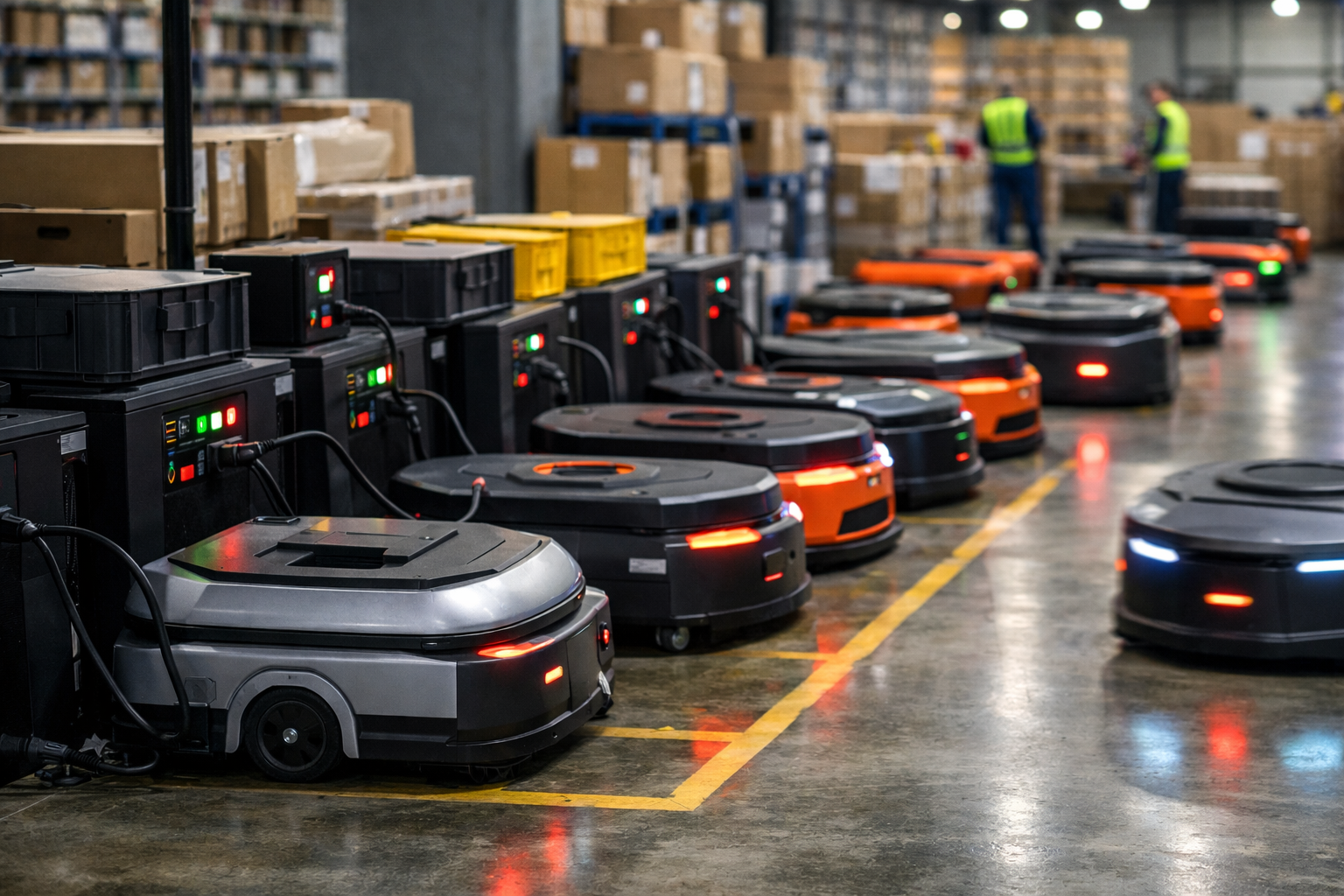
Mobile robots are becoming more efficient at almost every level.
New LiDAR sensors consume only a few watts. Fleet software is becoming more robot-agnostic. Manufacturers are improving navigation, perception and coordination across increasingly complex robotic fleets.
Yet one major source of lost productivity remains surprisingly conventional:
AGVs and AMRs still need energy, and many still have to stop productive work to get it.
For operators evaluating
AGV charging, AMR charging, wireless charging or opportunity charging, this creates a bigger question:
Is the objective to improve charging, or to improve robot fleet productivity?
That distinction is becoming increasingly important as autonomous mobile robot fleets scale.
Mobile Robots Are Being Optimized Watt by Watt
Recent robotics launches show how aggressively engineers are reducing power consumption inside the robot.
Benewake’s new NOVA20 solid-state LiDAR targets blind spots close to mobile robots. According to AGV Network, the sensor weighs less than five grams and consumes less than one watt on average.
Benewake NOVA20 coverage on AGV Network
Orbbec’s Pulsar MH24 provides 360-degree 3D LiDAR sensing for AMRs and other mobile robots while weighing approximately 210 grams and consuming less than four watts under typical operation.
Orbbec Pulsar MH24 coverage on AGV Network
These developments illustrate an industry engineering every component around greater efficiency.
Every watt matters.
Every gram matters.
Every interruption matters.
But when an entire robot becomes unavailable because it has to recharge, the productivity impact is much larger than a few watts saved at component level.
Why AGV and AMR Charging Is Really a Fleet Utilization Problem
Charging is often evaluated as a battery or electrical problem.
How large is the battery?
How quickly can it charge?
What is the charger output?
Should the system use conductive or wireless charging?
Those are important engineering questions.
But for the factory or warehouse operator, the business question is different:
How many productive hours does each robot deliver?
When an AMR or AGV must leave its workflow, travel toward a charging station, dock, charge and return, the operation loses productive robot time.
At fleet level, that can affect:
- robot availability
- fleet utilization
- throughput
- peak capacity
- charging-area congestion
- required fleet size
- floor space
- return on automation investment
This is why
AMR charging downtime and AGV charging downtime should increasingly be treated as productivity metrics.
Wireless Charging Does Not Necessarily Eliminate Charging Downtime
Wireless charging for AGVs and AMRs is becoming an increasingly visible category.
Wireless charging can remove physical electrical contacts and automate energy transfer.
That can provide meaningful benefits.
But
wireless charging and uninterrupted robot operation are not necessarily the same thing.
A wireless charging system can still require the robot to reach a defined charging location and remain there while energy is transferred.
The connector disappears.
The charging event remains.
For operators evaluating
wireless charging for AGVs or AMRs, the more useful question is therefore:
Does the technology simply remove the physical connection, or does it also recover productive robot time?
That is a very different performance metric.
From Opportunity Charging to In-Motion Power
Opportunity charging replenishes energy during available pauses in the robot’s workflow.
Instead of waiting for a long charging cycle, a robot receives smaller amounts of energy at selected points.
Power-in-Motion takes the idea further.
Rather than making charging a destination, energy is introduced into parts of the route the robot already uses.
CaPow’s Genesis platform uses strategically positioned modular transmitter antennas and a receiver installed on the robot. As compatible AMRs and AGVs travel across equipped sections of their normal routes, they can receive energy without being assigned a separate charging mission.
See how CaPow Genesis Power-in-Motion works
That changes the operating model from:
Work → leave workflow → charge → return to work
to:
Work → receive energy during normal operation → continue working
The technology transfers energy.
The business outcome is
productivity.
Mixed Robot Fleets Are Making Infrastructure More Important
Another recent industry development points in the same direction.
Körber announced an investment in NAiSE, a software company that coordinates AGVs, AMRs and manually operated industrial trucks from different suppliers.
NAiSE says its platform will remain open to different integrators and vehicle manufacturers.
Körber and NAiSE coverage on AGV Network
The broader trend is important.
Factories increasingly need infrastructure that works across different robots instead of requiring every operational layer to be tied to one OEM.
That is already happening in fleet management.
The same principle matters for energy infrastructure.
A facility operating multiple AMRs and AGVs does not necessarily want separate charging areas, operating rules and charging strategies for every robot platform.
Energy increasingly needs to become a
fleet-level infrastructure layer.
Genesis is designed around that principle: modular, robot-agnostic infrastructure positioned around the routes and operating patterns already used by the fleet.
Existing AGV Infrastructure Is Hard to Replace
Intel’s recent request for an FCC waiver involving foreign-made AGVs provides another useful lesson.
Intel asked for permission related to the continued use and maintenance of certain AGVs in its U.S. semiconductor factories. According to reporting on the filing, Intel said proven domestic alternatives meeting its requirements were not currently available and replacement could take years.
Intel AGV waiver coverage on AGV Network
The interesting point for the robotics industry goes beyond regulation.
Once an AGV fleet becomes part of production, replacing it is not simply a matter of buying another vehicle.
Routes matter.
Interfaces matter.
Loads matter.
Safety validation matters.
Production processes matter.
That should also influence how companies think about
AGV charging infrastructure.
Infrastructure that forces customers to redesign the operation creates friction.
Infrastructure that adapts to existing robot behavior has a fundamentally different deployment proposition.
Robot Economics Are Moving to the Foreground
Recent developments at Innok Robotics offer another sign of a maturing mobile robotics market.
Following shareholder approval for its planned stock-market transaction, financial information published around Innok showed €2.4 million in 2025 revenue and a growth plan approaching €100 million by 2030.
Innok Robotics financial analysis on AGV Network
Those numbers belong specifically to Innok, but they highlight a broader industry shift.
Mobile robotics is increasingly being evaluated not just on technical capability, but on economics.
For robot operators, the equation is even simpler.
Once a robot has been purchased, every non-productive hour reduces the utilization of that capital asset.
Which suggests a useful KPI:
productive robot hours.
How Does Charging Downtime Affect AGV and AMR Fleet Size?
Imagine an operation that needs a certain number of robots actively completing missions at all times.
If part of the fleet is regularly unavailable because of charging, the operator may need additional robots simply to maintain the required capacity.
Charging can therefore influence:
- fleet CAPEX
- robot utilization
- warehouse or factory throughput
- automation ROI
- battery requirements
- floor space allocated to chargers
Reducing charging-related downtime can change the economics of the entire fleet.
This is why CaPow positions Power-in-Motion as
productivity infrastructure for mobile robotic fleets, rather than simply as another charging technology.
Energy is the mechanism. Productivity is the outcome.
What Happens When Charging Downtime Is Removed?
This is not only a theoretical question.
In a published Hyundai Glovis proof of concept, CaPow compared conventionally powered robots with robots using Genesis Power-in-Motion.
The published results reported
100% fleet availability for the relevant CaPow-enabled robots and a 15% increase in operational efficiency during the evaluated operation.
Read the Hyundai Glovis Power-in-Motion case study
The significance is not simply that the robots received energy differently.
The operation recovered productive capacity that would otherwise have been lost to charging.
In another published Tier-1 automotive manufacturing deployment, CaPow reported 100% uptime and a 50% reduction in automation-related production losses.
Read the Tier-1 Automotive Manufacturer case study
These results are application-specific rather than universal guarantees, but they demonstrate why energy architecture can directly affect robotic fleet productivity.
What Is Power-in-Motion for AGVs and AMRs?
Power-in-Motion is an energy-delivery architecture in which compatible mobile robots receive energy during their normal operating cycle rather than relying exclusively on dedicated charging sessions.
CaPow’s Genesis platform uses modular transmitter antennas positioned at selected locations along normal robot routes.
The entire warehouse or factory floor does not need to be equipped.
Power zones can instead be positioned strategically based on:
- robot traffic
- route geometry
- queueing areas
- loading and unloading points
- natural dwell locations
- the robot’s energy requirements
This allows energy infrastructure to be designed around actual fleet behavior.
Power-in-Motion vs. Traditional Robot Charging
The difference is operational.
Traditional charging
Robot → charger → stop → receive energy → return to operation
Stationary wireless charging
Robot → wireless charger → stop → receive energy → return to operation
Opportunity charging
Robot → available pause → receive energy → continue
Power-in-Motion
Robot → normal operating route → receive energy → keep working
The goal is not simply to remove a charging cable.
It is to reduce or eliminate the productivity interruption associated with charging.
What Should Companies Evaluate When Comparing AGV and AMR Charging Solutions?
Companies comparing an
AGV charging system, AMR charging solution, opportunity charging system or wireless robot charging technology should look beyond charger specifications.
Useful questions include:
- How much productive time does each robot lose to charging?
- How often does the robot leave its normal route for energy?
- How much travel exists purely because of charging?
- What percentage of the fleet is unavailable at peak periods?
- Are extra robots required to compensate for charging downtime?
- How much floor space is dedicated to chargers?
- Can the infrastructure support multiple robot platforms?
- How will the charging architecture scale as the fleet grows?
- Could energy instead be delivered during the existing workflow?
Those questions reveal the operational cost of the charging architecture.
The Next Robotics Productivity Breakthrough May Be Outside the Robot
Sensors will become more efficient.
AI will become more capable.
Navigation will improve.
Fleet orchestration will become more sophisticated.
Batteries will continue evolving.
All of those advances matter.
But factories and warehouses do not ultimately buy robots because they want robots.
They buy
productive capacity.
That changes the optimization problem.
The goal is not simply to make each robot more sophisticated.
It is to make sure that the robots already on the floor spend as much of their time as possible doing useful work.
The robotics industry has spent years optimizing what is inside the robot.
The next productivity opportunity may be in the infrastructure around it.