Manufacturers continue to invest in automation to increase capacity, improve operational resilience and address persistent workforce challenges.
But deploying automation is only part of the equation.
Once autonomous mobile robots (AMRs) and automated guided vehicles (AGVs) become part of production, another question emerges:
How much productive capacity are you actually getting from the fleet you already own?
For many operations, the answer depends not only on the robots themselves, but on the infrastructure surrounding them.
Charging is one of those considerations.
When robots need to stop, detour or leave their operational routes to recharge, energy becomes more than a battery issue. It becomes an operational variable that can affect fleet availability, infrastructure requirements and ultimately the economics of automation.
Manufacturing Has a Capacity Problem
Manufacturers are under pressure to produce more while maintaining cost discipline and operational reliability.
Labor availability remains part of that challenge. Deloitte and The Manufacturing Institute have previously projected that 2.1 million U.S. manufacturing jobs could remain unfilled by 2030, illustrating the scale of the workforce challenge facing the sector.
Automation is one response.
Mobile robots can take over repetitive material movement and help manufacturers create more predictable flows between production processes.
But automation creates its own capacity questions.
A robot that is charging is still part of the capital investment in the fleet.
It simply isn’t performing productive work at that moment.
The Hidden Cost of Charging Downtime
Traditional mobile robot architectures typically depend on batteries that periodically require charging.
Different fleets address this in different ways: dedicated charging periods, opportunity charging, battery swapping or additional robots that compensate for units temporarily unavailable.
Each architecture has different economics.
The important point is not that one charging model is universally wrong.
It is that charging should be included in the capacity calculation.
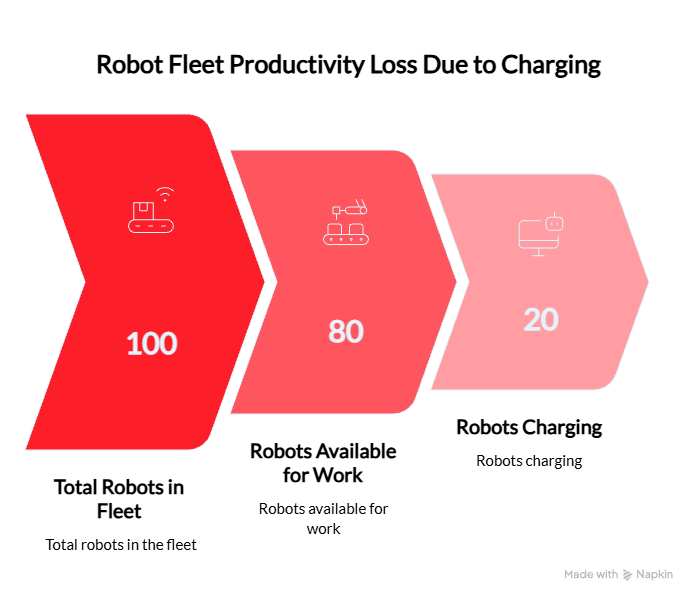
Consider a fleet that requires additional robots simply to maintain the required number of productive units while others charge.
The cost isn’t limited to electricity or batteries.
It may also include:
- Additional robots
- Charging infrastructure
- Floor space allocated to charging
- Robot travel to and from charging locations
- Battery replacement and maintenance
- Additional fleet coordination
As fleets grow, these costs can compound.
What Happens When Charging Is Removed From the Operating Cycle?
This is where continuous power delivery creates a different operating model.
Rather than asking a mobile robot to leave productive operation to obtain energy, Power-in-Motion delivers energy while the robot travels along its normal route.
CaPow’s Genesis platform is designed around this principle.
Facility-side antennas are strategically positioned along movement surfaces, while a lightweight receiver is integrated into the robot. The technology supports both new robot designs and retrofits of existing models and is designed to work across robot models and battery types.
The objective is simple:
Energy becomes part of the route instead of a reason to leave it.
That changes the capacity equation.
What Does That Mean in a Real Operation?
In a proof of concept conducted with Hyundai Glovis, traditionally powered AGVs experienced recurring charging interruptions during each eight-hour shift.
The CaPow-enabled robots maintained full operation without charging-related interruptions.
According to the published case study, the deployment resulted in:
100% fleet availability due to charging
15% increase in operational efficiency by eliminating charging downtime
Zero time lost to charging detours or return trips
No dedicated charging zones required
Read the Hyundai Glovis case study
These results belong to that specific proof of concept and should not be assumed for every facility.
But they illustrate an important principle:
Before adding more robots, understand why the robots you already own are unavailable.
Fewer Robots Can Change the Economics
Charging downtime is often treated as an unavoidable characteristic of battery-powered automation.
That assumption can influence fleet design from the beginning.
If an operation requires a certain number of robots continuously available, additional units may be incorporated into the fleet to compensate for charging periods.
Remove that constraint and the required fleet size can change.
This doesn’t mean every operation will need fewer robots. Fleet requirements depend on routes, payloads, cycle times, utilization, energy demand and many other factors.
But it introduces an important question into the automation business case:
Are you buying robots to create productive capacity, or are some of them compensating for the energy architecture of the others?
Five Questions Manufacturers Should Ask Before Expanding a Mobile Robot Fleet
Before adding capacity, manufacturers should understand the utilization of their existing automation.
- What percentage of fleet time is actually productive?
Separate productive operation from charging, waiting, congestion and other forms of inactivity.
- How much capacity is being added to compensate for downtime?
Determine whether fleet sizing includes additional units specifically to maintain availability.
- How much movement is related only to obtaining energy?
Charging doesn’t necessarily begin when the robot reaches the charger. Travel to and from charging locations can also consume operational time.
- What infrastructure does the current energy model require?
Include charging stations, floor space, electrical infrastructure and any operational restrictions they introduce.
- What happens when the fleet doubles?
A manageable inefficiency across ten robots can become materially different across 100.
The larger the fleet becomes, the more important these questions become.
Automation ROI Isn’t Just About the Robot
The economics of mobile robotics are often evaluated through robot price, labor savings and expected throughput.
Those metrics matter.
But they don’t tell the entire story.
The infrastructure required to keep the robot productive matters too.
A useful automation ROI calculation should therefore consider not only what a robot can do, but how much of its available operating time can actually be used to do it.
This shifts the conversation from robot performance to system performance.
The Future Is About Productive Capacity
Manufacturing automation will continue to advance.
Robots will become more capable. AI will improve orchestration. Fleet management systems will become more sophisticated.
But better robots alone cannot eliminate every operational constraint around them.
Energy is one of those constraints.
And as mobile robot fleets become larger, the way they receive energy becomes increasingly connected to throughput, fleet utilization and capital efficiency.
The question for manufacturers considering their next automation investment may therefore not simply be:
How many more robots do we need?
It may be:
How much more can we get from the robots we already have?
That is where the next layer of automation efficiency begins.
Sources
Deloitte – Manufacturing skills gap research
CaPow – Genesis Power-in-Motion technology
CaPow – Hyundai Glovis Case Study