 Booth A901 -

Artificial intelligence is transforming industrial robotics faster than almost any other layer of automation. Vision systems are improving. Navigation algorithms are getting smarter. Fleet orchestration software is becoming more autonomous.
Yet across warehouses, factories, and logistics centers, one fundamental constraint remains stubbornly unchanged: energy.
While AI continues to accelerate what robots can do, energy architecture still dictates how long they can do it, how reliably, and at what cost. And in mobile robotics, that constraint is becoming impossible to ignore.

AI in Robotics Is Advancing Faster Than Infrastructure
AI-powered mobile robots are now expected to operate continuously, adapt dynamically to changing environments, and collaborate safely with humans. These expectations are no longer experimental – they are being deployed at scale in logistics, manufacturing, and fulfillment operations worldwide.
But most facilities still rely on battery-centric energy models designed for an earlier generation of automation:
- Robots operate until batteries deplete
- They stop work to recharge
- Fleets require spare robots to cover downtime
- Charging zones consume valuable floor space

This model clashes directly with AI-driven operational goals such as:
- Continuous operation
- Predictable throughput
- Real-time task allocation
- High robot utilization rates
As AI increases robot intelligence, the cost of stopping becomes higher – not just in time, but in system-level efficiency.

The Hidden Cost of Battery-Dependent Automation
Battery limitations are not a chemistry problem alone. They are an architectural problem.
At fleet scale, battery-based energy introduces structural inefficiencies:
- Stop-start duty cycles reduce effective robot availability
- Charging schedules interfere with task orchestration
- Battery aging increases maintenance complexity
- Over-provisioning fleets becomes necessary to meet SLAs
As AI software becomes better at optimizing workflows, these constraints become the dominant limiter of performance.
In other words:
AI can optimize tasks, but it cannot optimize around energy downtime that is baked into the system.

Why Energy Architecture Matters More Than Ever
Energy delivery has quietly become one of the most strategic layers of automation design.
For mobile robots, energy is not just a power source – it determines:
- Whether fleets can operate continuously
- How much floor space is lost to charging
- How many robots are needed to meet throughput targets
- The total cost of ownership over the system’s lifetime
As AI-driven automation scales, the industry is beginning to recognize that energy must evolve from a consumable into infrastructure.
This is where architectural approaches like power-in-motion are gaining attention.
From Charging Robots to Powering Operations
CaPow was founded on a simple but radical idea:
Mobile robots should receive power as part of their operation – not as an interruption to it.
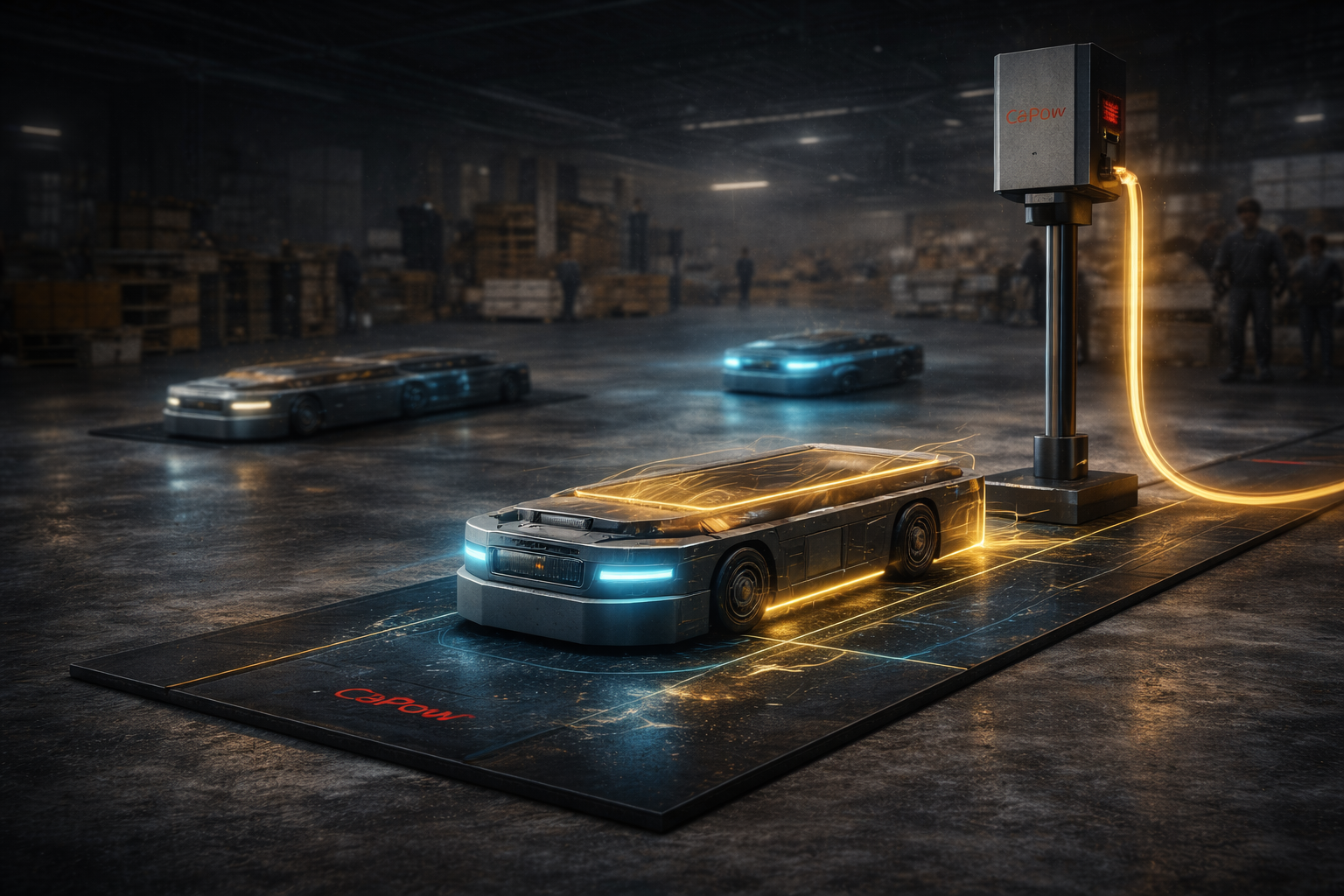
Instead of stopping to charge, robots receive energy while moving, using a capacitive power transfer system embedded into the floor. This shifts energy from a discrete event to a continuous process.
The result is not just fewer charging stops – it is a fundamentally different operational model:
- Robots remain active throughout shifts
- Charging zones are eliminated
- Fleet size can be reduced without sacrificing throughput
- Energy delivery becomes predictable and scalable
This architectural shift aligns naturally with AI-driven automation, where continuity and predictability are essential.
Why AI and Power-in-Motion Are Converging
AI excels at optimizing systems that are continuous.
Energy downtime breaks continuity.
By enabling robots to receive power while operating, power-in-motion removes a key variable from AI optimization models:
- No need to schedule charging windows
- No need to predict battery depletion mid-task
- No need to reroute robots for energy reasons
This allows AI systems to focus on what they do best:
optimizing flow, utilization, and decision-making across the fleet.
In practical terms, energy-aware AI becomes energy-agnostic.
Real-World Adoption Signals a Shift
Power-in-motion is no longer a theoretical concept. CaPow’s technology has been deployed in operational environments, including projects with global industrial players such as Hyundai, and has attracted investment from strategic investors including Toyota Ventures.
These signals matter because they reflect a broader industry realization:
- AI-driven robotics requires infrastructure-level thinking
- Energy is not a peripheral concern
- Continuous operation is becoming a baseline expectation
As automation maturity increases, architectural decisions made today will define operational limits for years to come.
Energy Efficiency Without the Battery Trade-Off
A common misconception is that improving energy efficiency means better batteries.
In reality, energy efficiency at fleet scale is determined by alignment between power delivery and operation, not just storage density.
Power-in-motion changes the equation:
- Smaller onboard energy storage is sufficient
- Thermal stress on batteries is reduced
- Maintenance cycles become more predictable
- Energy is delivered where and when it is needed
This does not eliminate batteries entirely in every application, but it repositions them as buffers rather than bottlenecks.
The Role of Software: Visibility and Control
As energy delivery becomes continuous, software plays a critical role.
CaPow’s Genesis platform is complemented by GEMS (Genesis Energy Management System), which provides fleet-level visibility into energy flow, usage patterns, and operational behavior.
This data layer supports:
- Better planning
- Smarter fleet orchestration
- Long-term optimization of energy infrastructure
Importantly, this is not a generic energy management system. It is designed specifically for mobile robot fleets, where energy, movement, and task execution are tightly coupled.
Why This Matters for the Future of Automation
The next phase of industrial automation will not be defined by smarter robots alone.
It will be defined by systems that are designed for continuity:
- Continuous motion
- Continuous power
- Continuous optimization
AI will accelerate this transition, but only if the underlying infrastructure can support it.
Energy is no longer an afterthought. It is a strategic enabler.
Rethinking the Automation Stack
As organizations invest in AI-driven robotics, the most important questions may no longer be:
- How smart are the robots?
- How advanced is the software?
But rather:
- How is energy delivered?
- How much downtime is structurally unavoidable?
- How scalable is the architecture over time?
CaPow’s approach challenges long-standing assumptions in industrial automation – not by adding another software layer, but by redefining how power itself is delivered.
In an era where AI promises continuous intelligence, continuous power may be the missing link.