
Introduction
Imagine a warehouse where autonomous robots work around the clock without ever pausing to recharge. As warehouse automation accelerates, energy solutions are emerging as the linchpin for uninterrupted operations. Powering these robots efficiently and sustainably is no longer just about cutting costs – it’s about enabling continuous productivity. Recent industry discussions have underscored the challenge: delivering reliable power to support complex tasks and extended duty cycles remains a persistent hurdle. CaPow.energy is committed to pushing these boundaries, pioneering innovations like continuous “power-in-motion” technology to keep robots moving 24/7. This article explores the current landscape of robot power, the cutting-edge solutions driving holistic energy management, and future trends that will shape warehouse and logistics robotics. By taking a comprehensive perspective on energy innovation beyond simple operational efficiency, we aim to solidify CaPow.energy’s role as a thought leader in this niche.
The Current Landscape: Challenges in Powering Warehouse Robots
Warehouses today are increasingly reliant on fleets of Autonomous Mobile Robots (AMRs) and Automated Guided Vehicles (AGVs) to move goods. Yet even the smartest robots are tethered by a classic bottleneck: how to keep them powered. Traditionally, mobile robots must periodically leave their tasks to dock at charging stations, which introduces significant limitations:
-
Downtime: Every trip to a charger creates gaps in productivity. In high-demand e-commerce environments, these idle minutes accumulate into lost throughput where “every second of uptime matters”. For example, many warehouse AMRs require 3–4 hours of charging per day, time during which they aren’t moving goods.
-
Infrastructure Strain: Charging stations require dedicated floor space and careful planning, adding to warehouse infrastructure costs. Allocating prime warehouse real estate for charging zones (instead of storage or operations) is a costly trade-off.
-
Battery Wear: Frequent deep charging cycles accelerate battery degradation. This means higher replacement costs and a bigger environmental footprint, as worn-out batteries add to e-waste.
To mitigate downtime, industry leaders have developed stopgap solutions. Some companies use wireless charging pads at strategic locations. Others employ battery swapping: robots like Sanctuary’s Phoenix can eject a depleted battery and insert a charged module within minutes, cutting downtime by up to 50% versus plugging in. These innovations from major players (Tesla, Boston Dynamics, Sanctuary AI, and more) highlight the growing need for efficient power solutions across robotics. However, they still share one drawback – the robot must stop, whether to align on a pad or perform a swap. In essence, even the most advanced current methods revolve around minimizing downtime rather than eliminating it entirely.

This is why the concept of on-the-go charging is so disruptive. In-motion charging – where robots receive energy continuously while moving – has emerged as a transformative approach to break the cycle of stop-and-charge. By tackling the energy bottleneck head-on, this paradigm shift promises to redefine how warehouse operations are powered. CaPow’s own technology is groundbreaking in this regard, delivering power perpetually so robots can operate without ever needing a pit stop.
Innovative Energy Solutions: Powering Robots Without Pause
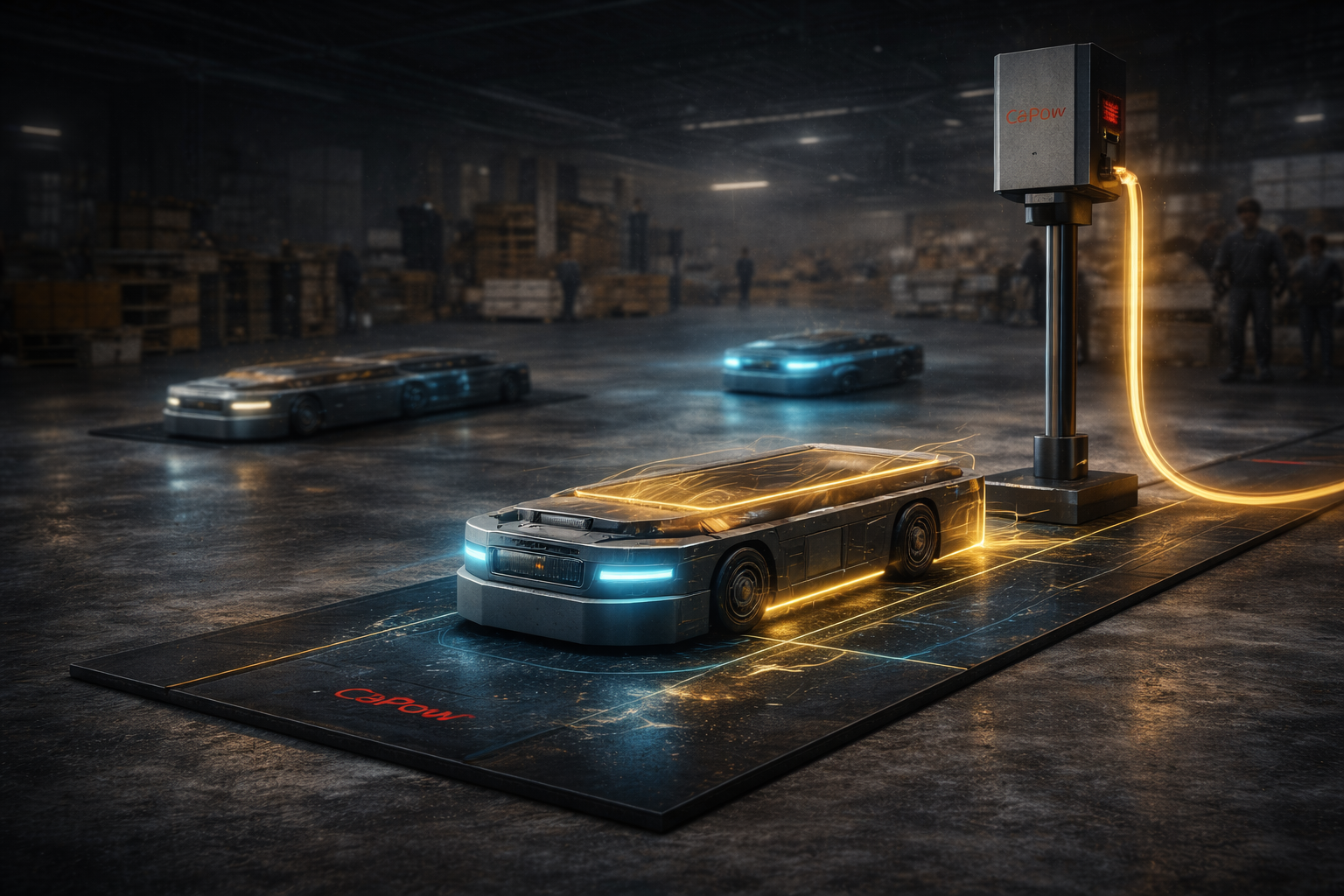
CaPow’s Genesis system exemplifies the cutting-edge in warehouse robot power. It provides wireless power-in-motion using technologies like capacitive power transfer via floor antennas, allowing robots to recharge dynamically as they transit or work. In practical terms, an AMR equipped with Genesis can patrol aisles or haul pallets all day, sipping energy from the warehouse floor – much like an electric vehicle charging while driving. This continuous trickle of energy keeps the robot in an “energy-positive” state, meaning the battery never fully depletes. As a result, robots can run with smaller on-board batteries (reducing weight and cost) while still maintaining maximum uptime. It’s a virtuous cycle: smaller batteries charge quicker and stress the system less, further extending battery lifespan and boosting efficiency.
Crucially, these innovations are designed to integrate seamlessly into existing operations. The Genesis power transfer system doesn’t require overhauling your robot fleet or facility layout. It’s hardware-agnostic and plug-and-play, compatible with essentially all robot makes, models, and battery types. Robots can be retrofitted via standard ports – no complex mounting or custom hardware needed – meaning one solution can electrify an entire mixed fleet. The energy is delivered through modular floor units that can be installed with minimal disruption, and even warehouse layout changes are simplified with tools like CaPow’s Floor Planner software. In other words, the system is as flexible as the operations it powers.
Beyond the hardware, CaPow.energy pairs its charging platform with intelligent software for holistic energy management. The Genesis Energy Management System (GEMS) provides real-time visibility and control over the fleet’s power usage. Operators can monitor each robot’s energy intake, track performance, and receive proactive alerts if any unit’s power draw is abnormal – enabling predictive maintenance and optimal energy distribution across the fleet. By analyzing usage data, GEMS can smartly allocate power where and when it’s needed most, avoiding bottlenecks or energy waste. This kind of end-to-end energy optimization ensures that power is not just delivered continuously, but also used intelligently.

Another hallmark of CaPow’s approach is its focus on sustainability and safety. Because robots no longer need massive batteries to last a full shift, material usage and battery waste are reduced. Continuous charging also avoids the high-current “fast charge” spikes that can cause energy loss – in fact, in-motion charging minimizes energy losses during transfer, aligning with global sustainability goals. All charging is done at safe power levels and is fully managed by the system, so there’s no risk of human error or unsafe charging practices. The result is an energy solution that is greener, safer, and more reliable than conventional methods.
Real-world results validate these benefits. In one case study, a warehouse that adopted CaPow’s power-in-motion reported nearly 100% robot uptime, drastically reducing both operating and capital costs. With charging downtime eliminated, the company avoided buying extra standby robots and cut energy-related delays to zero. The throughput jumped by hundreds of percent, and automation “work potential” expanded dramatically as robots became truly autonomous. Such success stories demonstrate how holistic energy management – combining continuous power delivery with smart software and sustainable practices – can revolutionize warehouse robotics. CaPow.energy isn’t just keeping robots charged; it’s enabling an entirely new level of operational efficiency and resiliency.
Future Trends: Energy Systems Evolving for Next-Gen Robotics
The coming years will bring even greater convergence between robotics and advanced energy technology. Industry analysts project the mobile robot market will double from $3 billion in 2021 to over $6 billion by 2027, fueled in part by innovations in energy solutionscapow.energy. To stay competitive, companies deploying robots will treat energy management as a strategic priority rather than an afterthought. Here are a few key trends on the horizon:
-
Perpetual Operations as the New Standard: The push toward continuous operation is broad-based across industries, from predictive maintenance systems to real-time data platforms that reduce downtime. In robotics, this means technologies enabling 24/7 uptime – like in-motion charging – will shift from novel to nearly mandatory. Those who invest early in continuous power infrastructure will “lead the charge” in automation excellence, enjoying greater throughput and ROI than competitors who stick with legacy charging routines.
-
Advanced Battery Technologies: Better batteries underpin longer runtimes, and new chemistries are on the way. Solid-state batteries (ASSBs), for example, promise dramatically improved safety and longevity – up to 20 years of service life with minimal capacity loss. These batteries can pack more energy into smaller sizes and tolerate more charge cycles, making them ideal for high-utilization robots. As ASSBs and other high-density cells become viable for commercial robots, they will complement continuous charging systems by further reducing maintenance and replacement needs. In parallel, supercapacitors are emerging as a powerful supplement for robotics: they can deliver quick bursts of power and recharge in seconds, useful for peak loads (like lifting a heavy package or a sudden acceleration) without straining the main battery. CaPow is already looking ahead – the company’s partnership roadmap includes exploring supercapacitor integrations to enhance power delivery for next-gen, heavier payload robots.
-
Alternative Energy Sources: While battery-electric power dominates indoor automation, some specialized robotics may tap alternative energy to extend operations. For instance, hydrogen fuel cells are being piloted for robots that need ultra-long endurance; a properly optimized fuel cell system can yield twice the energy density of lithium batteries and power an 8-hour shift with only water vapor as a byproduct. We are seeing early collaborations in this space (e.g., trials to use hydrogen for humanoid robots by 2027), and similar concepts could translate to warehouse vehicles or heavy AGVs in the future. However, challenges like hydrogen storage and new infrastructure mean batteries plus continuous charging will remain the more practical solution for most warehouses in the near term.
-
Ecosystem Collaborations: The future of robotic energy is not being forged in isolation – it’s a collaborative effort across tech providers, robotics OEMs, and facility operators. CaPow.energy’s growing list of partnerships illustrates this trend. In a recent collaboration, Peer Robotics (an AMR manufacturer) integrated CaPow’s in-motion charging into its robots, eliminating the typical daily charging downtime and allowing truly round-the-clock usage. By staying energy-positive throughout operation, Peer’s robots run smaller batteries yet achieve higher efficiency and faster ROI. Both companies benefit: CaPow gains a wider platform for its technology, and Peer offers more value to its customers. Such partnerships pave the way for deeper integration of energy systems into robot design – for example, joint development on supercapacitor-based power boosts is already in progress. We can expect more OEMs and solution providers to team up, ensuring that future robots are “born” with continuous power capabilities and that standards emerge for interoperability.
These trends all point to a singular vision: robotic fleets that work tirelessly, intelligently, and sustainably. The energy systems of tomorrow’s warehouses will be smarter and more resilient, blending hardware and software to optimize every joule of energy. CaPow.energy aims to remain at the forefront of this evolution, whether through refining its power-in-motion technology, embracing new battery innovations, or forging alliances that expand the possibilities of what warehouse robots can do.
5 Key Questions to Consider When Choosing Energy Solutions for Your Warehouse Robots
For businesses planning to upgrade their robotic fleets, selecting the right energy strategy is crucial. Here are five key questions to guide an informed decision:
-
How Much Downtime Can You Eliminate? – Start by assessing how many hours your robots currently spend idle for charging (it’s often more than you think). Solutions that allow opportunity charging or continuous in-motion power can reclaim this lost time. Every minute not charging is a minute a robot can be productive – in some cases, traditional systems consume 15% or more of a robot’s day on charging stops. Consider whether an energy solution can bring you significantly closer to 24/7 uptime.
-
What Infrastructure Does It Require? – Evaluate the operational footprint of the solution. Does it need dedicated charging rooms or bulky swap stations? Traditional chargers demand dedicated real estate and careful planning, whereas newer systems embed into your workflow with minimal space. Opt for energy delivery that integrates with existing infrastructure (e.g. floor-installed transmitters) to avoid expensive facility overhauls.
-
Is It Compatible with Your Current Robots and Workflow? – A fancy charging tech is of little use if it only works with specific models or disrupts your processes. Ensure the solution is hardware-agnostic and flexible. For instance, can it support different battery types and robot brands in your fleet? Also, consider integration effort – look for plug-and-play options that don’t require redesigning your robots or halting operations for long installations.
-
How Will It Impact Battery Life and Sustainability? – Not all charging methods treat your batteries (or the environment) equally. Frequent high-power charging can shorten battery lifespan, leading to more frequent battery purchases and waste. Check if the solution includes smart energy management that avoids deep discharge/charge cycles and monitors battery health. A system that uses continuous, gentle charging can extend battery life and reduce your e-waste and energy consumption – aligning with sustainability goals while cutting long-term costs.
-
What’s the Total Cost and ROI? – Look beyond the upfront price tag. Consider how the energy solution affects both operational expenses (OPEX) and capital expenses (CAPEX). A cheaper charger might require buying extra backup robots to cover downtime, whereas a continuous power system could let you run a smaller fleet at higher utilization, saving on robot purchases. Factor in productivity gains – if robots never stop, can you achieve more throughput with the same fleet? Often, the improved efficiency and uptime translate to a fast ROI, offsetting the initial investment in advanced charging infrastructure.
By reflecting on these questions, businesses can pinpoint an energy strategy that not only keeps their robots running, but also supports their broader operational and financial objectives.
Conclusion
Warehouse and logistics robots are only as powerful as the energy systems that drive them. As we’ve explored, innovative solutions like CaPow’s power-in-motion technology are shifting the narrative from managing downtime to eliminating it. By adopting a holistic approach – encompassing continuous charging, smart energy management software, and future-ready hardware – operations can unlock unprecedented levels of efficiency, sustainability, and autonomy. The future of warehouse automation will be defined by those who embrace cutting-edge energy solutions to keep their robots moving without pause.
In summary, investing in advanced power infrastructure is not just about keeping robots charged; it’s about enabling new workflows, reducing costs, and gaining a competitive edge in an increasingly automated world. Energy is the unsung hero of robotics innovation, and CaPow.energy is proud to lead the charge in transforming how robots are powered and managed.
Ready to supercharge your warehouse operations? Contact CaPow.energy today for a personalized consultation on implementing these next-generation energy solutions. Our experts will help evaluate your needs and chart a path toward 24/7 robotic productivity. Don’t let your automation potential be limited by old charging paradigms – let’s power the future of your warehouse together.