 Booth A901 -

February 2026 has been full of headlines about AI breakthroughs in logistics.
From predictive orchestration systems to real-time routing intelligence, automation vendors are showcasing fleets that think faster, reroute dynamically, and self-correct in milliseconds. Warehouse AI has matured. Decision-making is no longer the limiting factor.
But there’s a quiet contradiction hiding beneath the software layer.
Mobile robots are becoming smarter every month.
They are not becoming continuous.
And in high-density operations, that gap matters.
The Automation Industry Solved Navigation. It Didn’t Solve Energy.
Autonomous mobile robots (AMRs) and automated guided vehicles (AGVs) are now highly optimized for movement. AI models calculate traffic flow, reduce congestion, and maximize throughput across facilities operating 24/7.
Yet most of these robots still depend on a traditional battery charging cycle:
Operate → stop → dock → recharge → return to work.
This creates a structural pause embedded in the system design.
In a documented Hyundai Glovis deployment, traditional AGV clusters operated under a 6.75:1 work-to-charge ratio. In modeled 100-robot environments, maintaining full throughput required approximately 15 additional robots to compensate for charging downtime.
That is not a software issue.
It is an infrastructure assumption.
The Hidden Cost of Charging Downtime in Warehouse Automation
Charging downtime is rarely framed as a strategic problem. It is often treated as a normal operational event.
But its impact compounds at scale:
- Robots deviate from optimal routes to reach charging stations
- Charging zones consume valuable warehouse floor space
- Fleet sizing increases to compensate for unavailable assets
- Throughput variability increases during shift transitions
In a Tier-1 automotive manufacturing environment, charging inefficiencies resulted in 20% solution downtime and 25% fleet inflation. In certain clusters, synchronized full productivity occurred during only 30% of production time.
When automation density increases, these losses become economically visible.
The question shifts from:
“How efficient are our robots?”
To:
“How much of our installed capital is productive at any given moment?”

AI Optimizes Decisions. Infrastructure Enables Execution.
AI-driven warehouse automation has dramatically improved task allocation and orchestration.
But intelligent routing does not eliminate the need to stop and recharge.
This is where many AI-forward automation strategies encounter diminishing returns.
When intelligence is layered over discontinuous infrastructure, performance plateaus. The more optimized the software becomes, the more visible the physical constraint underneath it becomes.
The industry is now reaching that inflection point.
Why 2026 Is a Turning Point for Robot Fleet Uptime
Several trends converging this year are amplifying the energy question:
- Increased automation density in large fulfillment centers
- Expansion of goods-to-person and high-throughput micro-fulfillment systems
- Continued labor constraints pushing toward higher automation reliance
- Rising capital scrutiny on automation ROI
As operators deploy larger fleets of AMRs and AGVs, traditional charging infrastructure scales poorly.
Energy does not scale linearly.
More robots mean:
- More charging stations
- More coordination overhead
- More capital tied up in non-productive assets
At scale, charging architecture becomes a financial variable.

From Battery Management to Energy Architecture
Most warehouse automation projects still treat energy as a late-stage decision.
The typical approach:
Design the flow → size the fleet → then plan charging zones.
This sequencing embeds downtime into the system from the beginning.
An alternative approach asks a different question:
What if energy availability were continuous rather than periodic?
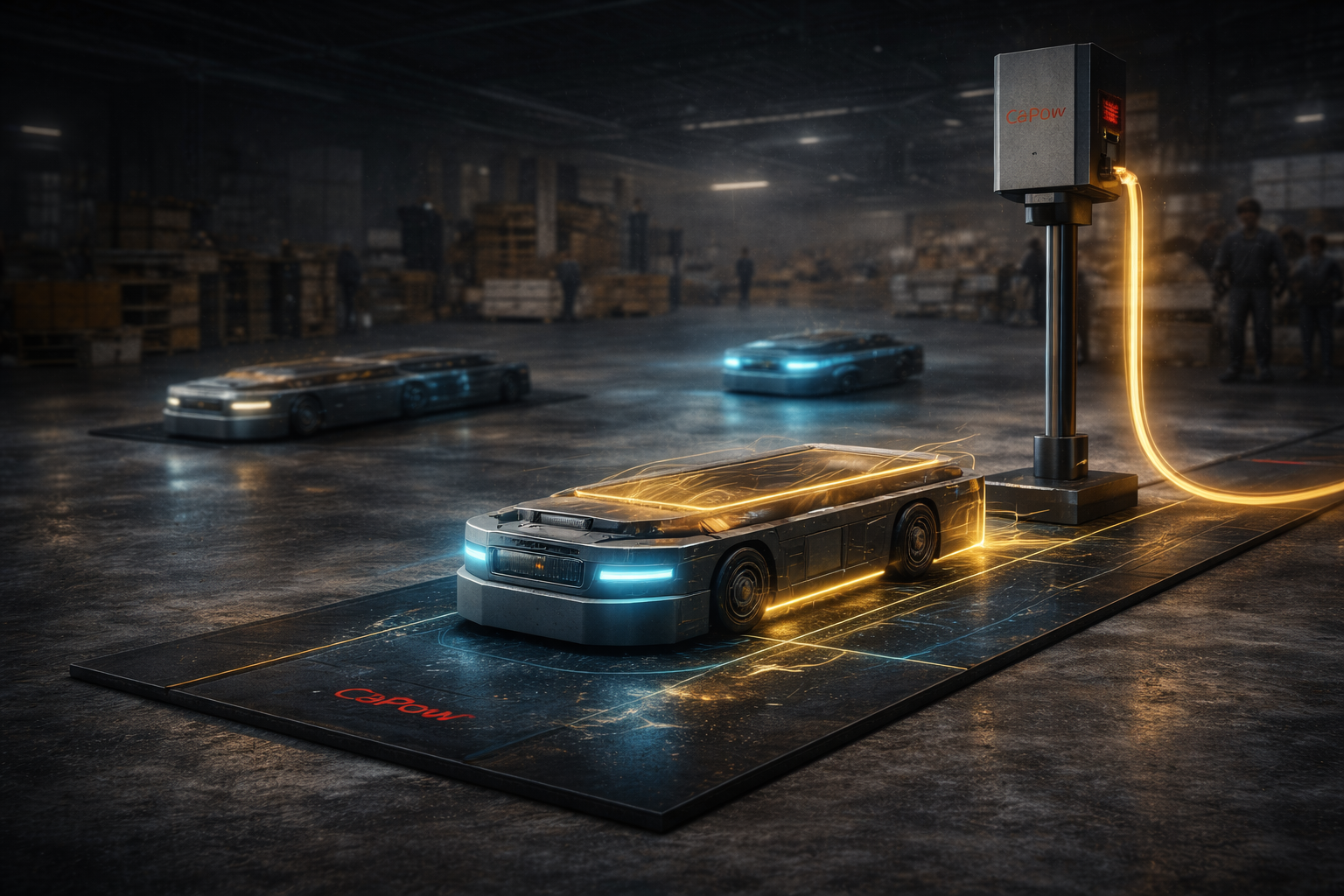
When robots receive power while operating – instead of stopping to charge – several structural shifts occur:
- Fleet inflation decreases
- Charging travel routes disappear
- Floor space can be reclaimed
- Operational density increases
In controlled side-by-side testing, fleets receiving energy during operation maintained full uptime across shifts, while traditionally charged robots experienced significant downtime windows.
The implication is larger than efficiency.
It affects how automation systems are designed.
Automation ROI Is Moving from Scale to Density
For years, automation ROI was justified by labor substitution and throughput expansion.
The logic was simple:
Deploy more robots → move more goods.
But as capital budgets tighten and facilities mature, the metric is shifting.
It is no longer just about how many robots are deployed.
It is about:
How much productive work is extracted per installed asset?
If 15%-25% of a fleet is unavailable due to charging cycles, scaling the fleet increases capital exposure without proportionally increasing output.
That is not a software optimization problem.
It is an energy design problem.

The Question Operators Should Be Asking in 2026
As AI continues to advance warehouse automation, operators and integrators should ask:
- What percentage of our fleet is productive at peak hours?
- How many robots exist solely to compensate for charging downtime?
- How much floor space is allocated to charging infrastructure?
- Would our system architecture look different if charging were removed from the critical path?
The next wave of automation maturity will not be defined solely by smarter algorithms.
It will be defined by whether infrastructure aligns with that intelligence.
Energy Is Becoming Visible
For two decades, supply chain visibility focused on inventory, labor, and routing.
Energy remained invisible.
Now, as automation density rises, energy architecture is becoming measurable.
And measurable constraints tend to become strategic priorities.
Warehouse automation has entered a new phase:
AI made robots smarter.
The next competitive advantage will belong to those who make them continuous.