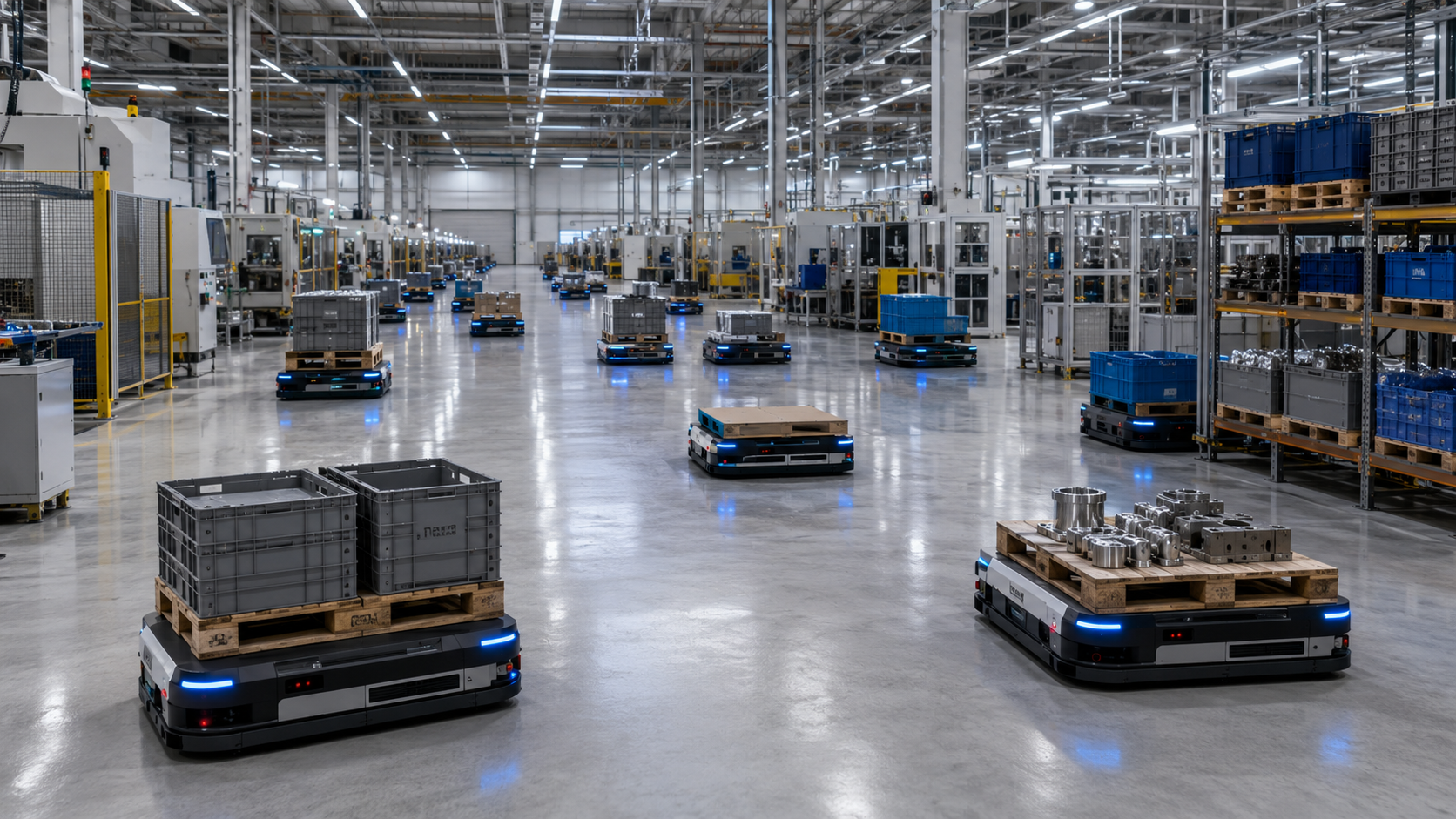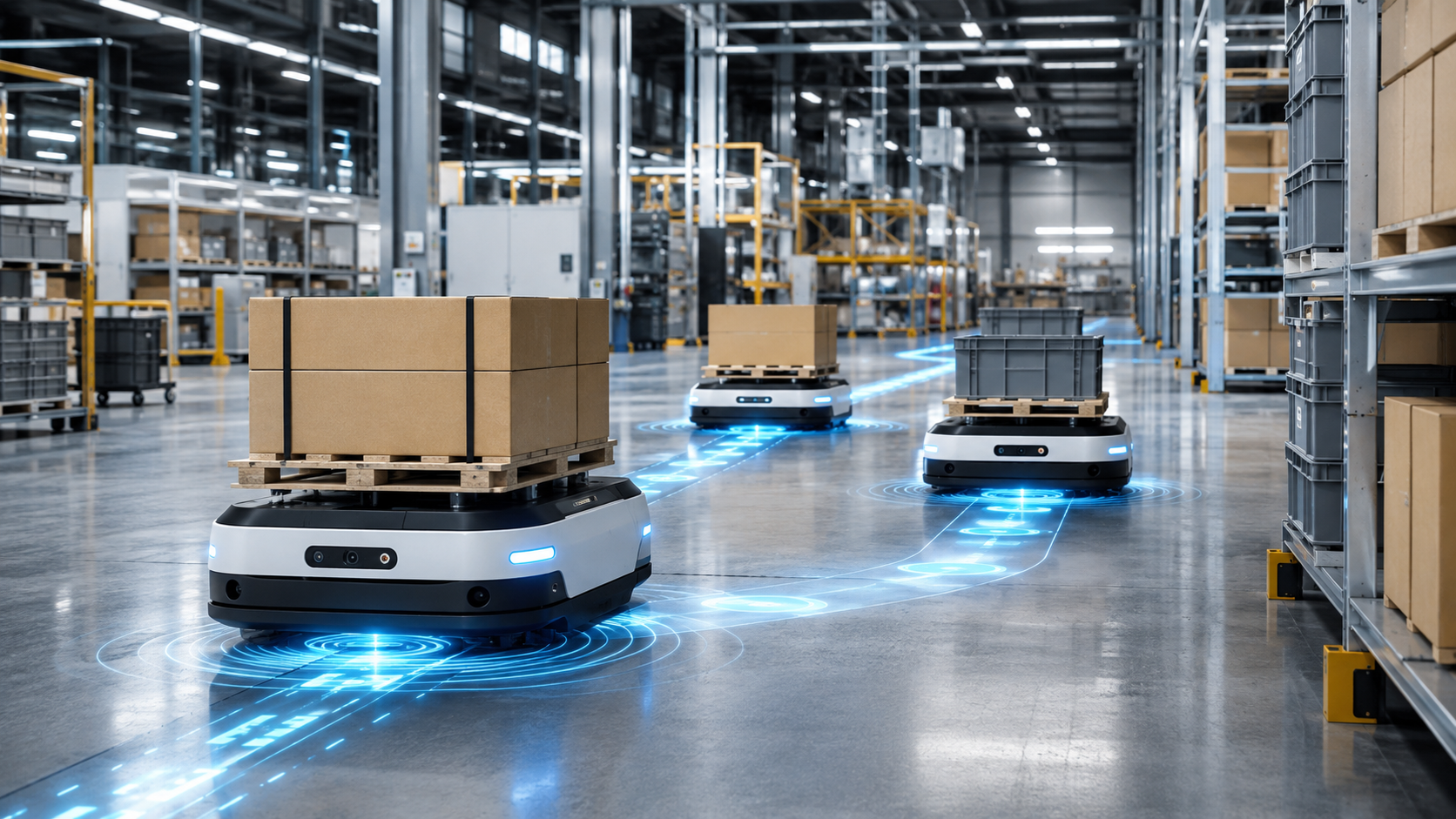
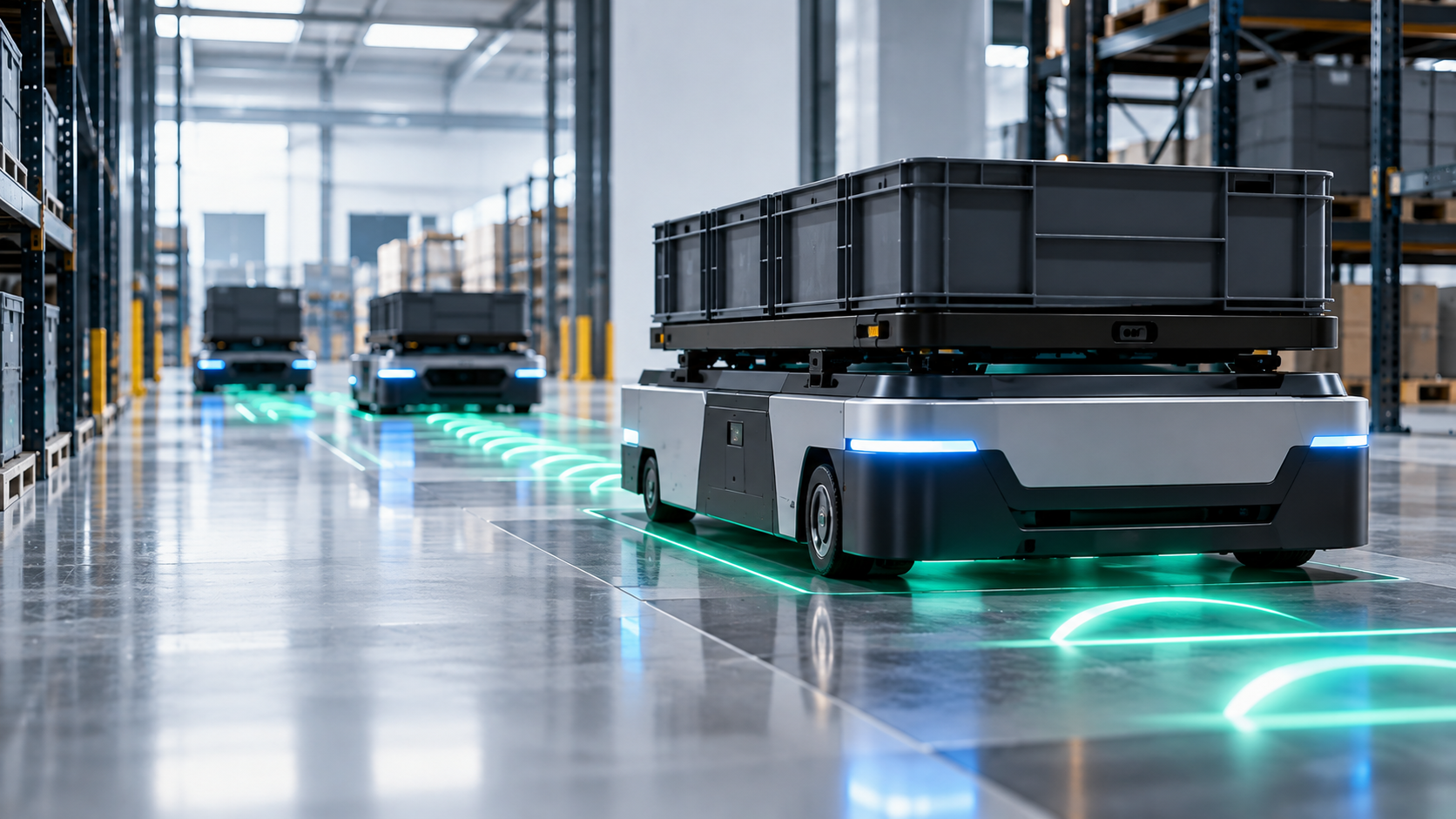
Autonomous mobile robots are becoming a standard part of modern warehouses, factories and distribution centers. But one operational constraint has remained largely unchanged: robots still need to stop working to recharge.
For companies operating large AMR and AGV fleets, this creates a simple but expensive problem.
A robot that leaves its workflow to charge is temporarily unavailable for productive work.
The traditional response has been to optimize charging schedules, add more charging stations or increase fleet size to compensate for robots that are offline. A different approach is emerging: delivering energy to robots while they are already operating.
That is the principle behind Power-in-Motion.
What is Power-in-Motion for mobile robots?
Power-in-Motion is an energy-delivery approach that allows autonomous mobile robots and automated guided vehicles to receive power during their normal operating cycle.
Instead of sending a robot to a dedicated charger, energy is delivered at selected points along routes the robot already travels.
This means the robot can receive energy while:
- moving
- slowing down
- waiting
- queueing
- working at a station
The goal is not simply to charge faster.
The goal is to remove charging as a separate operational event.
Why does charging downtime matter in AMR and AGV operations?
Charging affects more than battery availability.
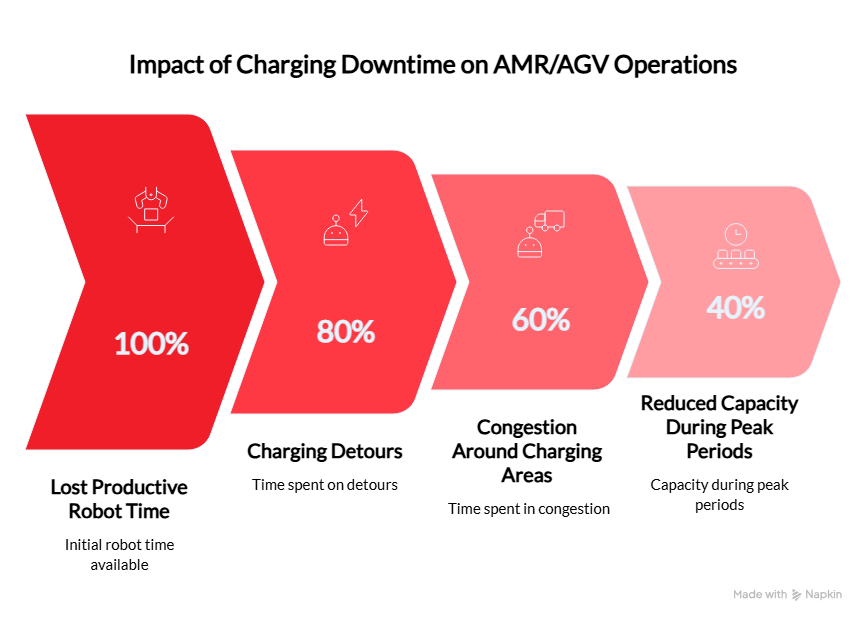
When robots stop for energy, operators can experience:
- lost productive robot time
- charging detours
- congestion around charging areas
- dedicated floor space for chargers
- reduced capacity during peak periods
- additional fleet requirements to compensate for unavailable robots
Many facilities therefore size fleets not only around the amount of work that needs to be completed, but also around the percentage of robots that may be unavailable at any given time.
That means energy infrastructure can directly affect fleet economics.
Can mobile robots really operate without dedicated charging stops?
In suitable applications, yes.
The critical requirement is maintaining a positive energy balance across the robot’s operating cycle.
That means the robot must receive enough energy during its normal workflow to replace the energy it consumes.
The relevant question is therefore not simply:
How fast can the robot charge?
It is:
Can the robot receive enough energy during normal operations to avoid leaving the workflow for charging?
This depends on several factors, including:
- average robot energy consumption
- robot speed
- duty cycle
- route geometry
- traffic patterns
- time spent at recurring stations
- available locations for energy transfer
- battery architecture
For this reason, continuous mobile-robot power should be designed at the operational level, not evaluated only by looking at the charger specification.
How does CaPow’s Genesis Power-in-Motion system work?
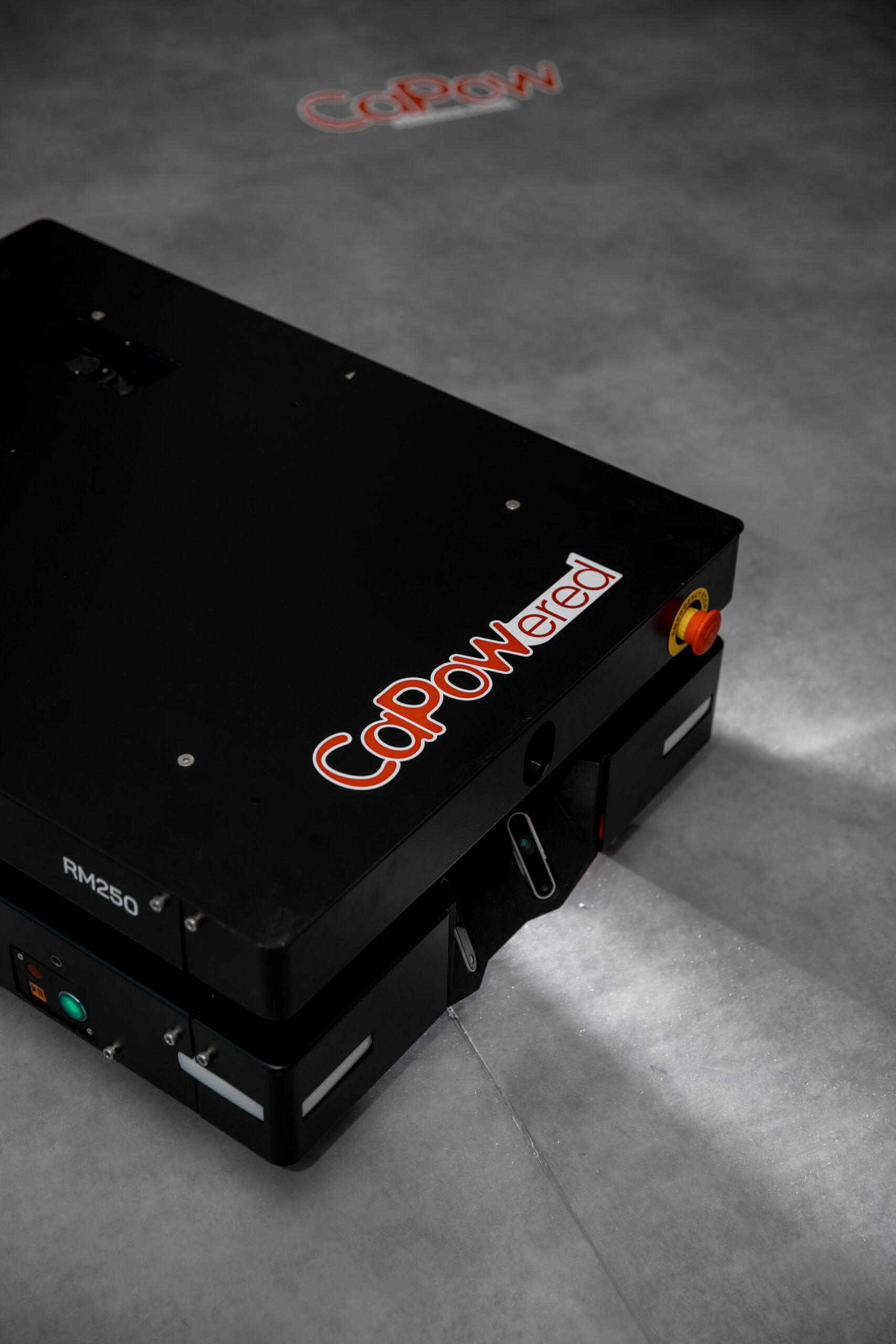
CaPow’s Genesis platform uses strategically positioned transmitter antennas and a receiver installed on the robot.
As the robot travels across or remains near an energized section of its normal route, it receives energy without leaving the workflow.
Genesis is designed as a modular, robot-agnostic infrastructure layer that can support different types of AMRs and AGVs.
The current platform is rated at 500 W, supports a 12-60 V DC output range, up to 30 A, and efficiency of up to 88%. It supports dynamic movement at speeds of up to 5 m/s and lock-in time of approximately 10 milliseconds.
The system includes:
- transmitter electronics
- modular transmitter antennas
- robot-side receiver antenna
- receiver electronics
- GEMS, the Genesis Energy Management System
GEMS provides real-time energy monitoring, remote support, proactive maintenance and operational insights across the Genesis fleet.
Does Power-in-Motion require changing robot routes?
The purpose of the architecture is the opposite.
Rather than routing robots toward energy infrastructure, the energy infrastructure is positioned around the robot’s existing operating pattern.
CaPow’s approach is designed to place power zones along high-value points already present in the operation, such as:
- pick stations
- intersections
- queueing areas
- loading points
- recurring high-traffic routes
- natural dwell locations
The result is that energy becomes part of the operating environment rather than another destination the fleet-management system must manage.
Does Power-in-Motion work with different robot brands?
The Genesis architecture is designed to be platform agnostic.
CaPow has worked across multiple mobile-robot configurations, including goods-to-person robots and AMR platforms.
The important variables are not primarily the brand name of the robot. They are the robot’s:
- voltage
- power consumption
- battery architecture
- available receiver space
- operating profile
- route geometry
This is why the same energy infrastructure concept can potentially support heterogeneous robot fleets while each robot receives an appropriate receiver configuration.
What operational impact can eliminating charging downtime have?
The impact depends on the individual site, but real-world testing demonstrates why the issue matters.
In a Hyundai Glovis proof of concept, the CaPow-enabled robot cluster remained active while the conventionally powered cluster experienced recurring charging interruptions. The published case study reported 100% fleet availability for the relevant CaPow-enabled robots and a 15% increase in operational efficiency.
In a separate manufacturing use case involving a Tier 1 automotive supplier, CaPow materials report that charging-related spare robots were returned to productive use, automation-related production losses were reduced by 50%, and the system achieved 100% uptime.
These results should not be interpreted as universal performance guarantees. They demonstrate the potential operational impact when the energy equation and operating environment are suitable.
How is Power-in-Motion different from fast charging?
Fast charging improves the speed of the charging event.
Power-in-Motion aims to remove the charging event from the operating cycle.
That distinction matters.
With conventional fast charging:
Work → Leave workflow → Charge → Return to work
With Power-in-Motion:
Work → Receive energy during operation → Continue working
The objective is therefore productivity, not charging speed.
Energy is the enabling infrastructure.
How is Power-in-Motion different from opportunity charging?
Opportunity charging typically uses stationary points where the robot must stop intentionally to receive power.
Power-in-Motion expands this concept by allowing energy transfer to occur within naturally occurring robot behavior, including movement and normal operational dwell time.
The difference is subtle but important.
Instead of asking the operation to adapt to the energy system, the energy system is designed around the operation.
Can Power-in-Motion reduce the number of robots required in a fleet?
Potentially.
If a facility has purchased additional robots specifically to compensate for charging downtime, improving fleet availability may allow the operator to recover productive capacity from the existing fleet.
This does not mean every facility can reduce its robot count.
Fleet sizing also depends on throughput requirements, peak demand, redundancy, maintenance strategy and operational design.
But when charging downtime is one of the reasons a fleet is oversized, eliminating that downtime can improve utilization and reduce the need for excess capacity.
Can Power-in-Motion reduce charging infrastructure?
Potentially, yes.
Traditional fleets may require dedicated charging zones, chargers, access areas and traffic management around those locations.
A distributed energy infrastructure can reduce dependence on centralized charging areas by moving energy delivery into the workflow itself.
That can be particularly valuable in facilities where floor space is constrained.
Which applications are best suited for Power-in-Motion?
The strongest applications tend to have several characteristics:
- repetitive robot routes
- high fleet utilization
- multi-shift operations
- recurring traffic concentration
- meaningful charging downtime
- pressure to increase throughput without adding robots
- limited floor space for charging infrastructure
Typical environments include:
- warehouses
- distribution centers
- automotive manufacturing
- goods-to-person systems
- industrial material movement
- high-throughput fulfillment operations
What information is needed to evaluate a mobile robot fleet?
A proper assessment should begin with operating data rather than simply counting robots.
Useful inputs include:
- robot manufacturer and model
- fleet size
- battery voltage
- average and peak power consumption
- battery capacity
- current charging behavior
- hours of operation
- robot route maps
- traffic heat maps
- recurring dwell points
- throughput requirements
- floor and infrastructure constraints
These inputs make it possible to determine whether enough energy can be delivered during the normal workflow to maintain the required energy balance.
Is continuous energy delivery the same as wireless charging?
Not exactly.
“Wireless charging” describes the energy-transfer mechanism.
“Power-in-Motion” describes the operational outcome.
That distinction is important because a wireless charger can still require a robot to stop working.
The business value comes from integrating energy delivery into the operating cycle so that receiving power no longer creates productive downtime.
What is the future of energy infrastructure for autonomous mobile robots?
As robotic fleets grow, energy management is likely to become a larger systems-level issue.
Warehouse operators already optimize robot routing, task allocation, congestion and throughput. Energy is increasingly becoming another variable that must be designed into the automation architecture.
The next stage is therefore not simply better batteries or faster chargers.
It is infrastructure that allows robots to remain productive while receiving the energy they need.
That shifts the conversation from:
How should we charge our robots?
to:
Why should robots stop working to receive energy at all?