When 40 Centimeters Cost $40 Million
In one large-scale operation, a decision was made to expand each workstation by just 40 centimeters.
The cost: $40 million.
The outcome: saving 300,000 seconds per day.
This is not about layout. It is about what operations are optimizing for.
At scale, time is energy.
And energy is becoming the constraint everything else must align with.
The Shift: From Automation Performance to Energy Allocation
For years, the conversation in automation focused on intelligence, orchestration, and throughput.
That is no longer where the constraint sits.
As large facilities expand and energy demand rises, operations are starting to plan around electricity as a limited resource. In several U.S. markets, integrators are already required to present detailed projections of energy consumption as part of tenders. Not as a secondary metric, but as a core requirement.
In parallel, large organizations are beginning to measure energy not just at the facility level, but at the cycle level.
Watt-seconds per task.
Per robot.
Per movement.
This is a different way of thinking.
Energy is no longer consumed in bulk.
It is allocated with precision.
Small Units, Massive Impact
A saving of a few watt-seconds per cycle sounds negligible.
It isn’t.
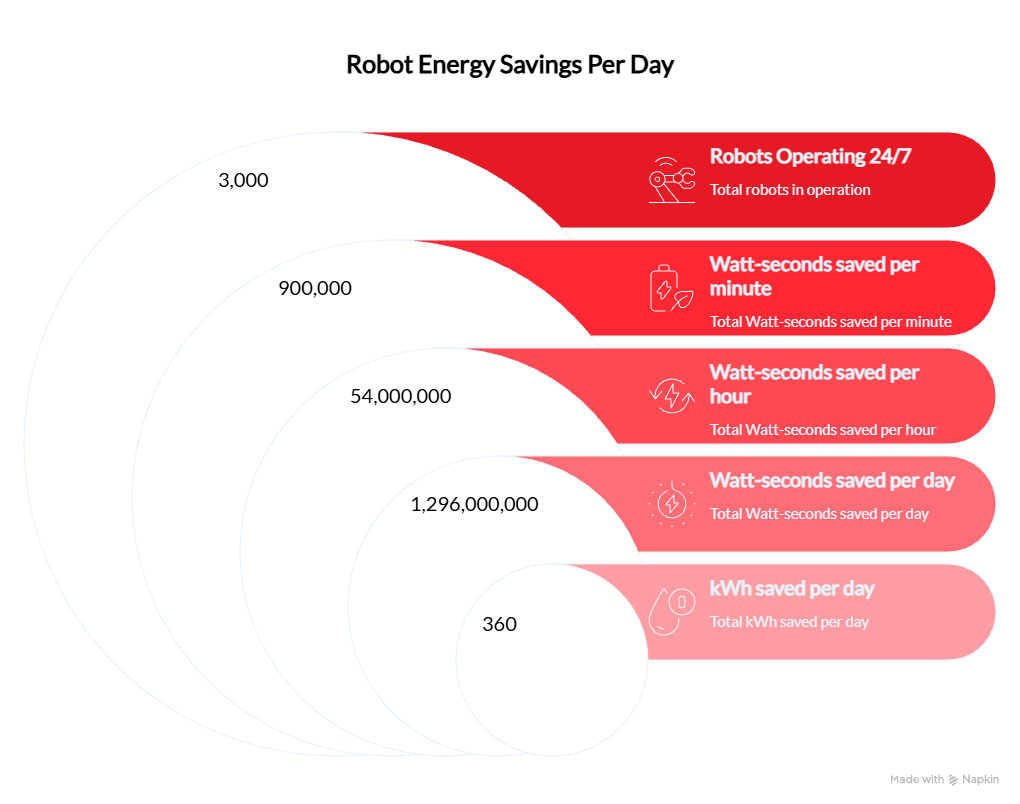
Take a fleet of 3,000 robots operating 24/7.
Save just 5 watt-seconds per minute per robot.
Multiply that across 24 hours, across the entire fleet, across global operations.
What looks like a marginal improvement becomes a measurable financial impact at the corporate level.
More importantly, it creates capacity.
Energy saved on one line can be reallocated to open another.
Efficiency is no longer just reduction. It is expansion.
The Hidden Constraint: Charging
Despite advances in robotics, one limitation remains structurally embedded.
Charging.
Robots stop.
Operations adapt.
Charging requires time, space, and additional infrastructure. It forces operators to overbuild fleets to compensate for downtime. It introduces planning complexity into systems that are otherwise designed for flow.
At the same time, battery-based systems are introducing additional constraints.
In some environments, energy storage units are physically isolated, placed behind protective barriers, supported by fire suppression systems. In others, there is growing hesitation from insurers to underwrite lithium-heavy operations.
The result is a system where energy is both a bottleneck and a risk.
A Different Model: Energy That Moves With the Operation
If energy is the constraint, the solution is not to store more of it.
The solution is to deliver exactly what is needed, exactly when it is needed.
This is where a different model emerges.
Instead of charging, energy is delivered in motion.
Instead of storing excess energy, systems draw only what the process requires.
This changes the equation.
No downtime.
No charging areas.
No overprovisioning.
Energy becomes part of the flow.
Why This Matters Now
This shift is not theoretical.
In large-scale deployments already underway, hundreds of robots are expected to operate under this model within months, scaling to larger fleets shortly after.
At the same time, organizations are beginning to calculate energy at the level of individual cycles. Even savings measured in tens of watt-seconds per loop are being translated into global financial impact.
In some cases, this is already influencing procurement decisions.
Integrators are being asked a new question:
How much energy will this system consume, precisely?
Beyond Efficiency: Energy as a Growth Enabler
What is emerging is not just a push for efficiency.
It is a redefinition of what energy represents in automation.
Energy is no longer a cost center.
It is a capacity driver.
The ability to control, allocate, and optimize energy at a granular level determines how much an operation can scale within its existing constraints.
This is why the conversation is shifting.
Not toward better charging.
But toward eliminating the need for it.
The New Benchmark
Automation is entering a phase where continuity is expected.
Not optimized. Expected.
Systems that still rely on stopping to recharge are operating on an outdated assumption: that energy can remain external to the workflow.
That assumption is breaking.
Energy is becoming the resource everything must align with.
And the ability to deliver it precisely, in motion, and without interruption is quickly becoming the new benchmark.