 Booth A901 -
Scaling Automation Exposes a Different Constraint
As warehouse automation continues to scale, a pattern is emerging that is not immediately intuitive. Organizations are investing in more robots, more advanced orchestration systems, and increasingly sophisticated AI layers. In many cases, these investments deliver measurable improvements in the early stages. However, as systems grow, performance gains tend to plateau, and in some environments, additional complexity even begins to reduce overall efficiency.
This is often misdiagnosed as a software or optimization problem. In reality, it is neither.
The limitation is structural.
The Assumption Built Into Every System
Most automated warehouse systems today are built around an assumption that is rarely questioned: robots do not operate continuously. They operate in cycles. They move, execute tasks, and then, at some point, they must stop in order to receive power.
That interruption is treated as an operational detail rather than a defining constraint. At small scale, that assumption holds. At system scale, it becomes the dominant factor shaping performance.
When Downtime Becomes a System-Level Problem
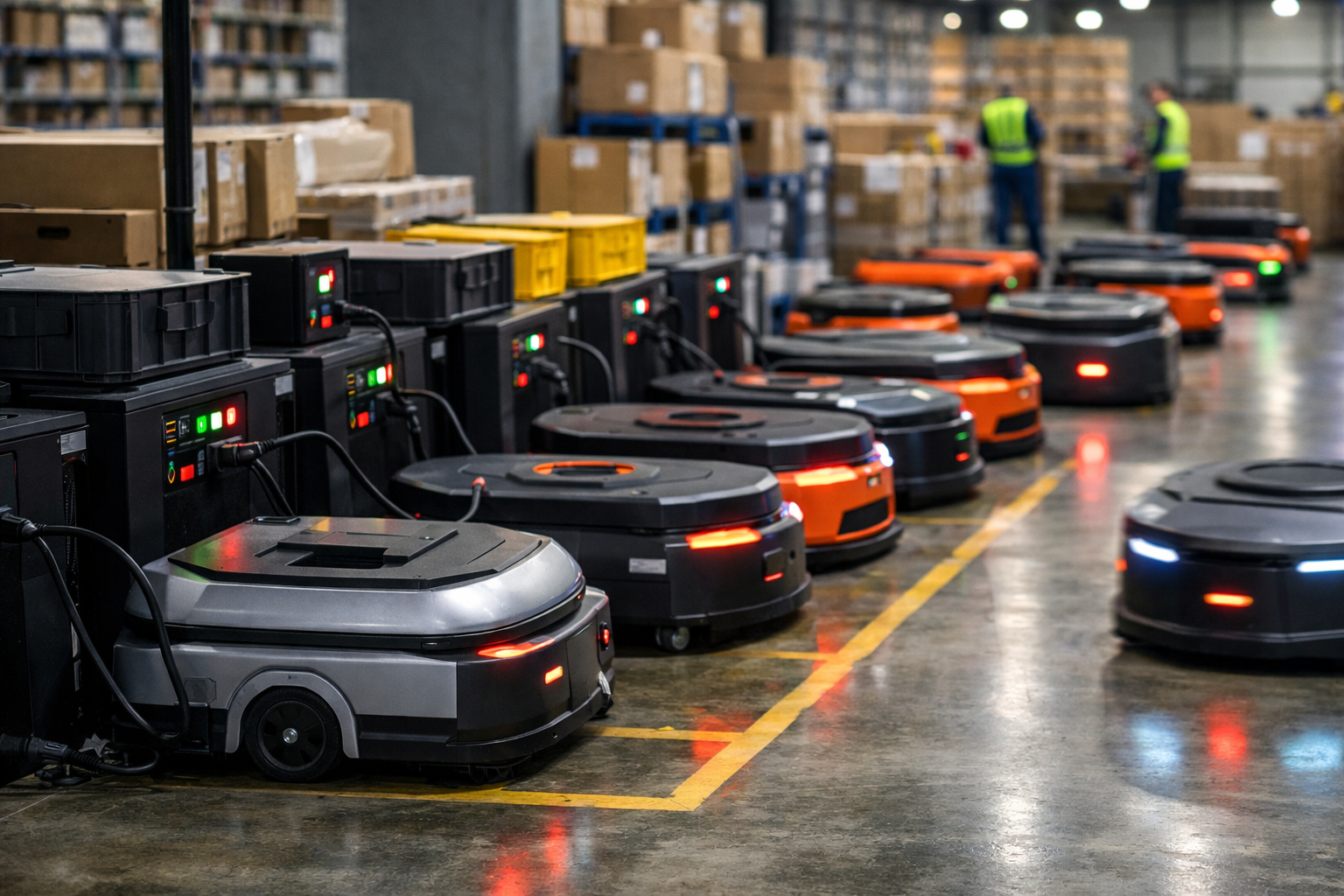
Once this is understood, a number of otherwise puzzling outcomes begin to make sense. Fleet sizes increase not only to meet demand, but to compensate for periods of inactivity. Charging infrastructure expands and begins to occupy valuable floor space. Throughput becomes dependent not only on task orchestration, but on energy scheduling.
The system is no longer optimized around work. It is optimized around interruption.
Why Adding More Robots Stops Working
This is the reason why adding more robots does not solve the problem. It addresses capacity, but it does not address availability. As long as a portion of the system is inactive at any given time due to charging requirements, the only way to maintain output is to overbuild.
This introduces additional cost, additional coordination overhead, and ultimately diminishing returns.
A Pattern Already Visible in AI Infrastructure
This constraint is not unique to warehouse automation. It is already visible in other domains, particularly in large-scale AI systems.
Jensen Huang has described modern AI infrastructure as increasingly power-limited. In practical terms, this means that performance is no longer defined only by compute capacity, but by the ability to deliver energy continuously and reliably.
What Quantum Systems Make Obvious
This becomes even clearer in the context of Quantum Computing.
Quantum systems are highly sensitive to interruption. They require continuous, stable energy conditions, and even minor disruptions can affect performance. As a result, infrastructure is not treated as a supporting layer. It is treated as part of the system itself.
Quantum computing does not introduce a new constraint. It exposes one that already exists.
From Cycles to Continuity
The same principle applies to industrial automation. As long as systems are designed around intermittent operation, performance will be constrained regardless of how intelligent or optimized they become.
The alternative is not incremental improvement. It is a change in architecture.
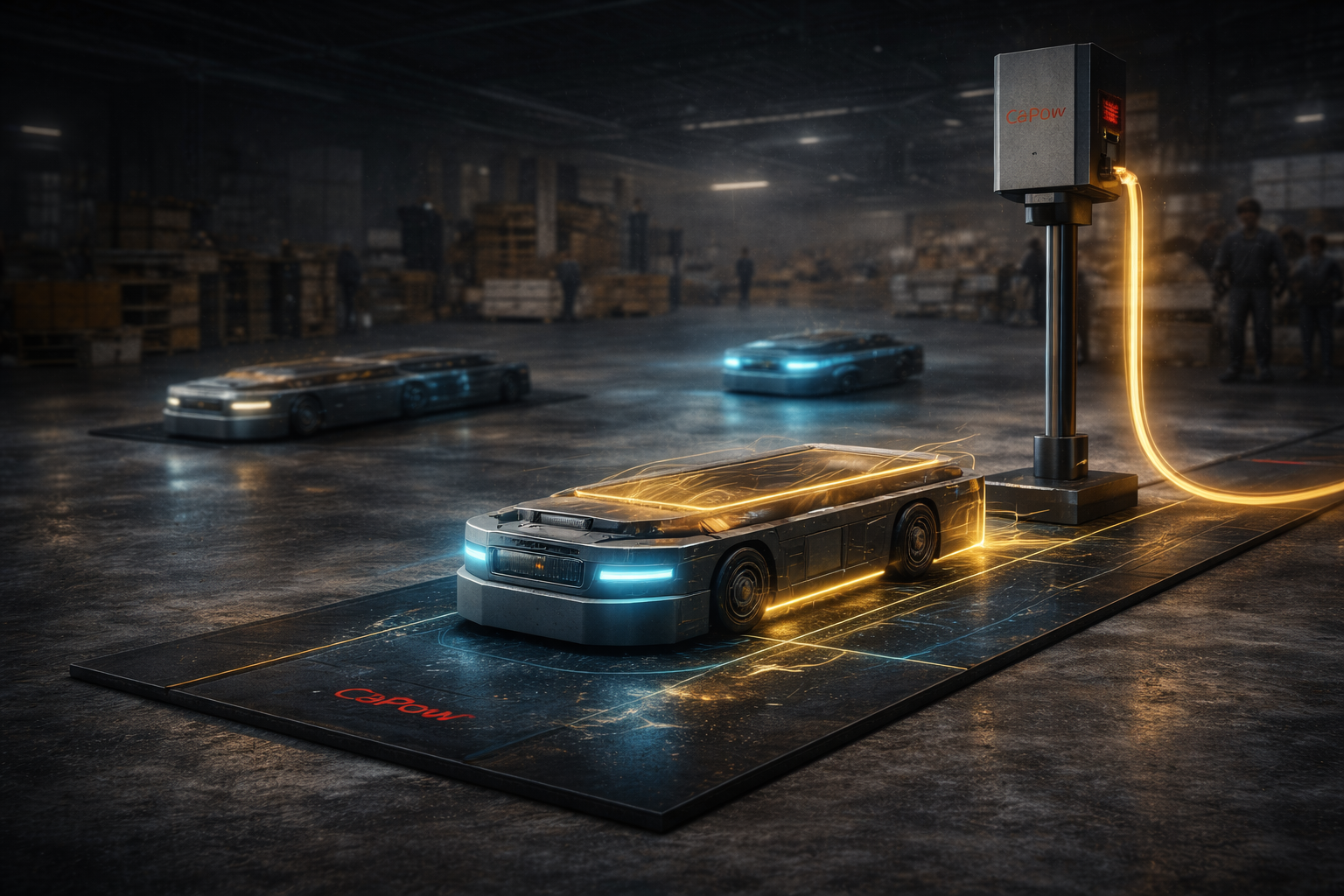
If robots are able to receive power during operation, the system no longer needs to be designed around charging cycles. Availability increases because robots are no longer taken offline. Fleet size can be reduced because over-provisioning is no longer required. Infrastructure becomes more efficient because dedicated charging areas are minimized.
Most importantly, throughput becomes a function of operational demand rather than energy constraints.
What This Means for System Design
This is the principle behind continuous energy delivery systems such as CaPow’s Power-in-Motion platform. Instead of optimizing when robots stop, the system removes the need for stopping altogether.
For operators, integrators, and OEMs, the implications are straightforward. Performance is no longer determined solely by the intelligence of the system, but by whether the underlying infrastructure allows that intelligence to operate without interruption.
Conclusion: The Question That Actually Matters
As automation continues to scale, the industry will continue to invest in intelligence, optimization, and orchestration. These remain important.
However, the defining question is shifting.
Not how many robots are deployed.
Not how advanced they are.
But whether the system they operate within allows them to work continuously.